
Summary
Blake Murphy is a stroke survivor, author of Still Here, and AI Enthusiast. In this post, he shares how breaking his silence after a March 2023 stroke — through therapy, writing, and honest conversation — helped him heal. His key message: silence doesn’t protect you, it isolates you. Talking about your pain is not a weakness. It is the first step toward working with it.
I spent years thinking silence was strength.
If I talked about what hurt, I’d be a burden. Dramatic. Weak. So I kept it in. I worked harder. I moved faster. I convinced myself that carrying it alone meant I was handling it.
I wasn’t handling it. I was just hiding it better.
When Everything Stopped: My Stroke in March 2023
When I had my stroke in March 2023, that system stopped working. My body forced a stillness I had spent my whole life running from. And in that stillness, everything I had buried started surfacing.
Childhood stuff. Grief for my mom. Fear I had never named. The weight of raising a daughter alone at eighteen. The shame of needing help when I had always been the one who figured things out.
I didn’t want to talk about any of it.
What Happened When I Finally Started Talking
But I started to. Slowly. In therapy first. Then in writing. Then out loud with people who stayed in the room when I said the hard things.
And something shifted.
Not all at once. Not dramatically. But the weight got lighter. Not because the pain disappeared, but because it stopped being a secret.
Why Silence Doesn’t Protect You — It Isolates You
Here’s what I learned:
Silence doesn’t protect you. It isolates you. It makes you think you are the only one who has ever felt this broken. It turns pain into shame. And shame is heavier than anything else you will carry.
Talking About It Doesn’t Mean Performing Your Trauma
Talking about it doesn’t mean performing your trauma for an audience. It doesn’t mean posting about it online or turning your worst moments into content.
It means finding one honest conversation. One person who can hold it with you. One therapist. One journal. One phone call you’ve been putting off.
That’s it. Start there.
You Are Not Broken for Hurting
If your life feels heavy right now, I want you to know something.
You are not broken for hurting. You are not weak for struggling. You are not a burden for needing help. You are not defined by the worst moments of your life.
You are the choices you make after everything falls apart.
And if you are reading this, you are still making them.
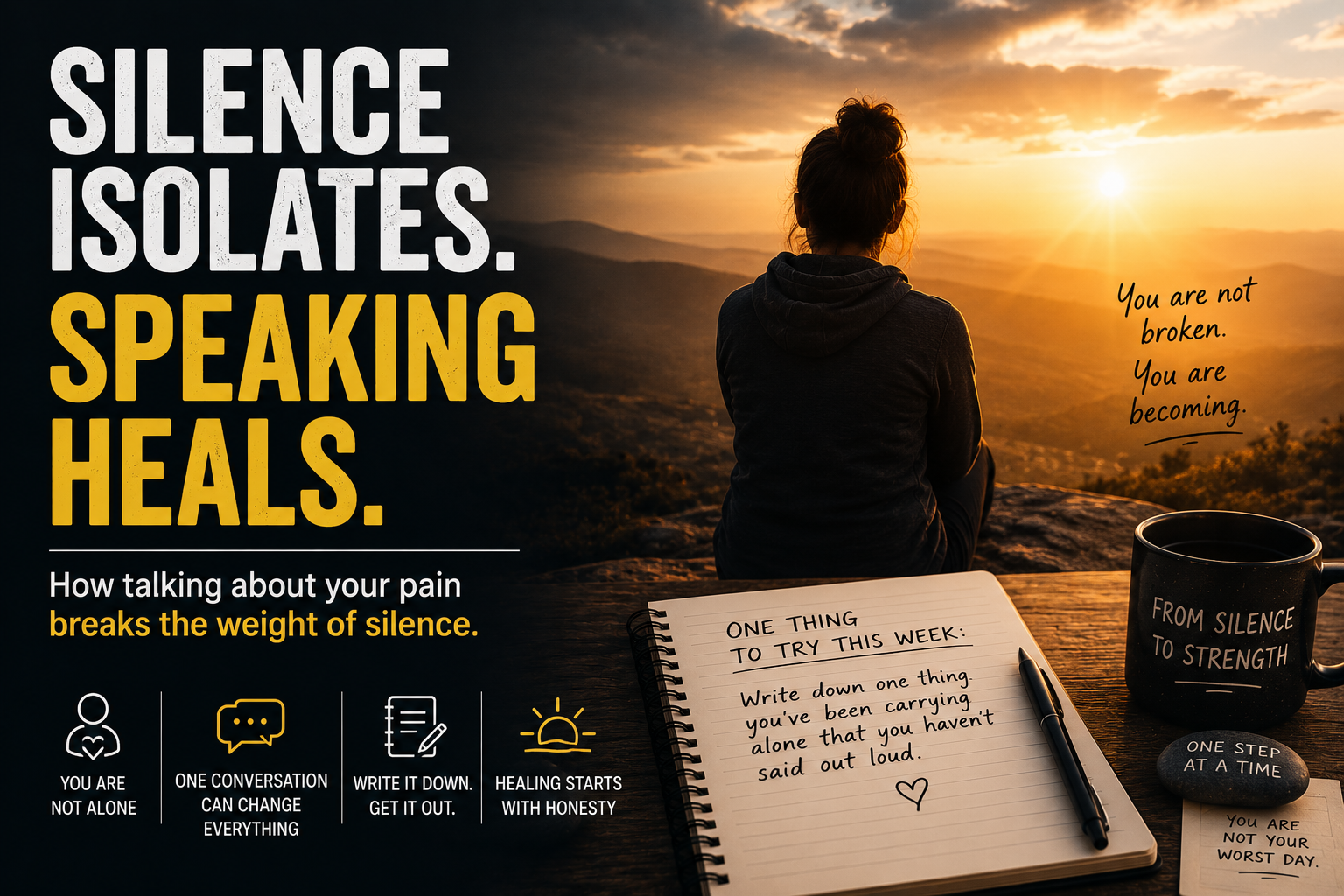
One Thing to Try This Week
Write down one thing you have been carrying alone that you haven’t said out loud to anyone. You don’t have to share it. You don’t have to do anything with it yet. Just write it down. Getting it out of your head and onto paper is the first step from silence to something you can actually work with.
Frequently Asked Questions
Is talking about your pain a sign of weakness?
No. Talking about your pain is not a sign of weakness. Silence can turn pain into shame and isolate you from the support you need. Speaking honestly — with a therapist, a trusted person, or in writing — is one of the most courageous and effective steps toward healing.
How do you start talking about something painful?
Start small. You don’t need an audience. Find one honest conversation — with a therapist, a close friend, or even in a private journal. Write down one thing you’ve been carrying alone. Getting it out of your head and onto paper is the first step from silence to something you can work with.
What is the connection between silence and shame?
When we keep pain to ourselves, it stops being just pain and becomes shame. Silence creates the illusion that we are uniquely broken. Shame thrives in secrecy. Speaking your experience — even to one person — breaks the cycle and lets you begin to process what you’ve been carrying.
What should I do if my life feels heavy right now?
You are not broken for hurting. You are not weak for struggling. You are not a burden for needing help. Start by writing down one thing you have been carrying alone that you haven’t said out loud. You don’t have to share it. Just getting it out of your head is the first step. Then consider finding one person — a therapist, a friend, or a support line — to share it with.
