
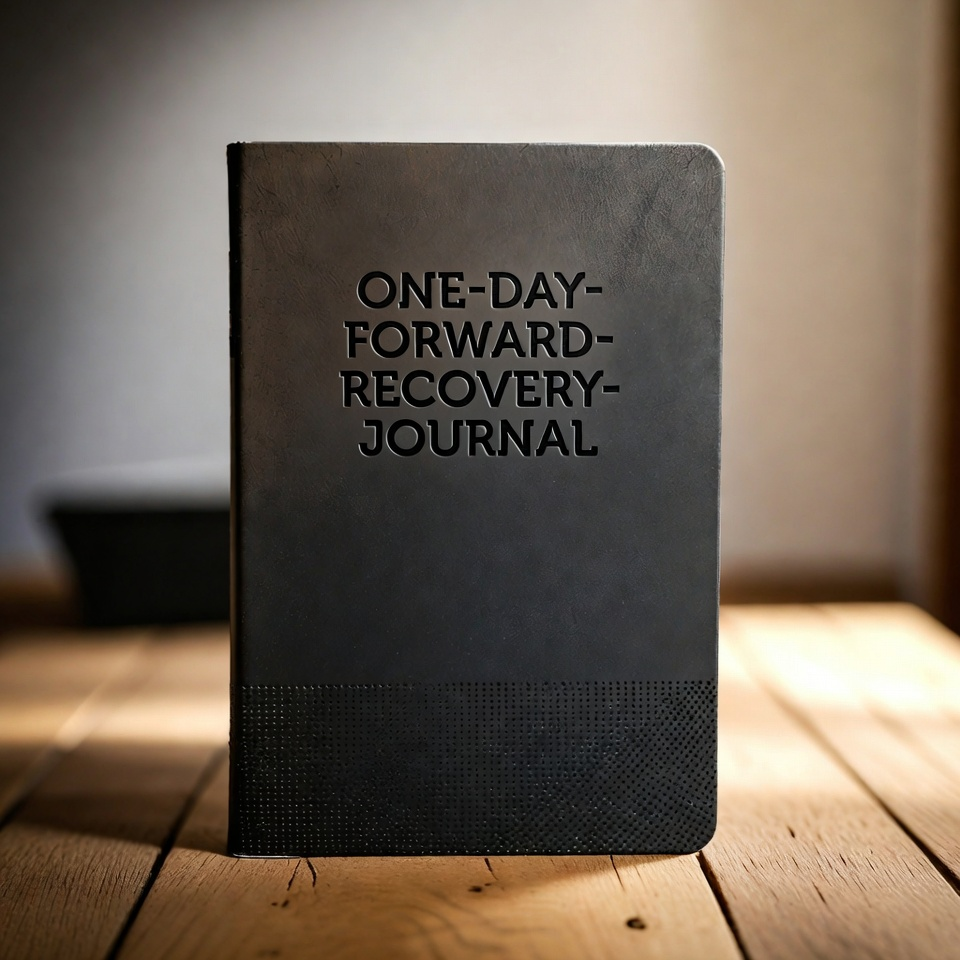
The short answer: The best recovery journal is the one that still works on your worst day. That means no streaks, no all-or-nothing rules, and pages small enough to finish in two minutes. I built One Day Forward on one idea from systems thinking: small inputs, repeated, change the whole system over time.
Hey, Blake here. Stroke survivor, author of Still Here, and a guy who has abandoned more journals than he’s finished. This post is about the one format that finally stuck, and why.
Why Most Journals Fail During Recovery
Most journals are designed for people at full capacity. Blank pages. Daily streaks. Prompts that assume you have energy and insight on tap.
Recovery is the opposite condition. Some days you have two sentences in you. Some days you have none.
So the journal becomes one more thing you’re failing at. You miss three days, the streak dies, and the journal goes in a drawer.
A missed day is data, not failure. Any journal that treats it differently will not survive recovery.
What Is Reflective Recovery Journaling?
Reflective recovery journaling is the practice of recording small daily observations during recovery: what you intended, what you noticed, what drained you, and what you’re learning. The goal is pattern recognition, not self-improvement.
It works because recovery progress is too slow to see day to day. You need a record to see it at all.
The Systems-Thinking Idea Behind It
Here’s the core idea: you don’t have to fix everything. You have to notice, adjust, and show up again.
In systems thinking, small inputs repeated over time change the whole system. One honest line a day is a small input. Thirty of them is a feedback loop. Ninety is a map of your own recovery that no doctor can give you.
That’s the entire method. Notice. Adjust. Show up again.
What’s Inside One Day Forward
Six re-printable page types, each small on purpose:
- Daily Reset. One intention, one small step, one thing to let go of.
- Energy & Fog Tracker. Find your good hours and protect them.
- “What is this teaching me?” A page for hard days and setbacks.
- Small Input, Real Change. Track the one tiny thing that adds up.
- Weekly Review. Look back without judgment.
- The Identity Page. For remembering who you still are.
It’s a printable PDF, US Letter, large readable type. Print any page as many times as you need. It works great in a binder with sheet protectors.
Motivation vs. Systems
| Motivation | A system | |
| Available on bad days | No | Yes |
| Depends on mood | Yes | No |
| What a missed day means | Failure | Data |
| Gets easier over time | No | Yes |
Motivation is unreliable. Systems are scalable. Recovery is long. Bet on the one that shows up every day.
Paper or Digital?
I use both. Paper slows me down in a good way. Digital finds patterns I’d miss.
If you want the digital version of these same pages, with the tracking handled for you, that’s the Brain Recovery Dashboard for Notion. And on days when even one line feels impossible, I lean on AI to get unstuck. Those exact prompts are in the AI Cognitive-Prosthetic Prompt Pack.
In Short
- Most journals fail in recovery because they’re built for full capacity.
- A missed day is data, not failure.
- Small inputs, repeated, change the whole system. That’s the method.
- Six small pages: reset, energy tracker, setback page, small inputs, weekly review, identity.
Get it here: One Day Forward Reflective Recovery Journal ($9.99). Instant download. Print pages as many times as you need.
FAQ
What is One Day Forward?
A printable guided journal for stroke survivors and anyone rebuilding after a health or life disruption. Six small page types you reuse, built on systems thinking instead of streaks.
What if I miss days?
Nothing breaks. There are no streaks. A missed day is data about your energy, not a failure.
How long does a daily entry take?
Two to five minutes. On hard days, one line still counts.
Is this therapy or medical advice?
No. It’s a personal reflection tool, not medical or psychological advice, and not a substitute for professional care.
Is there a digital version?
Yes. The Brain Recovery Dashboard for Notion carries the same core pages into Notion with tracking built in.
This post describes a personal reflection tool. It is not medical or psychological advice.

Leave a Reply