
Most advice about gratitude comes from people having a good year. This isn’t that.
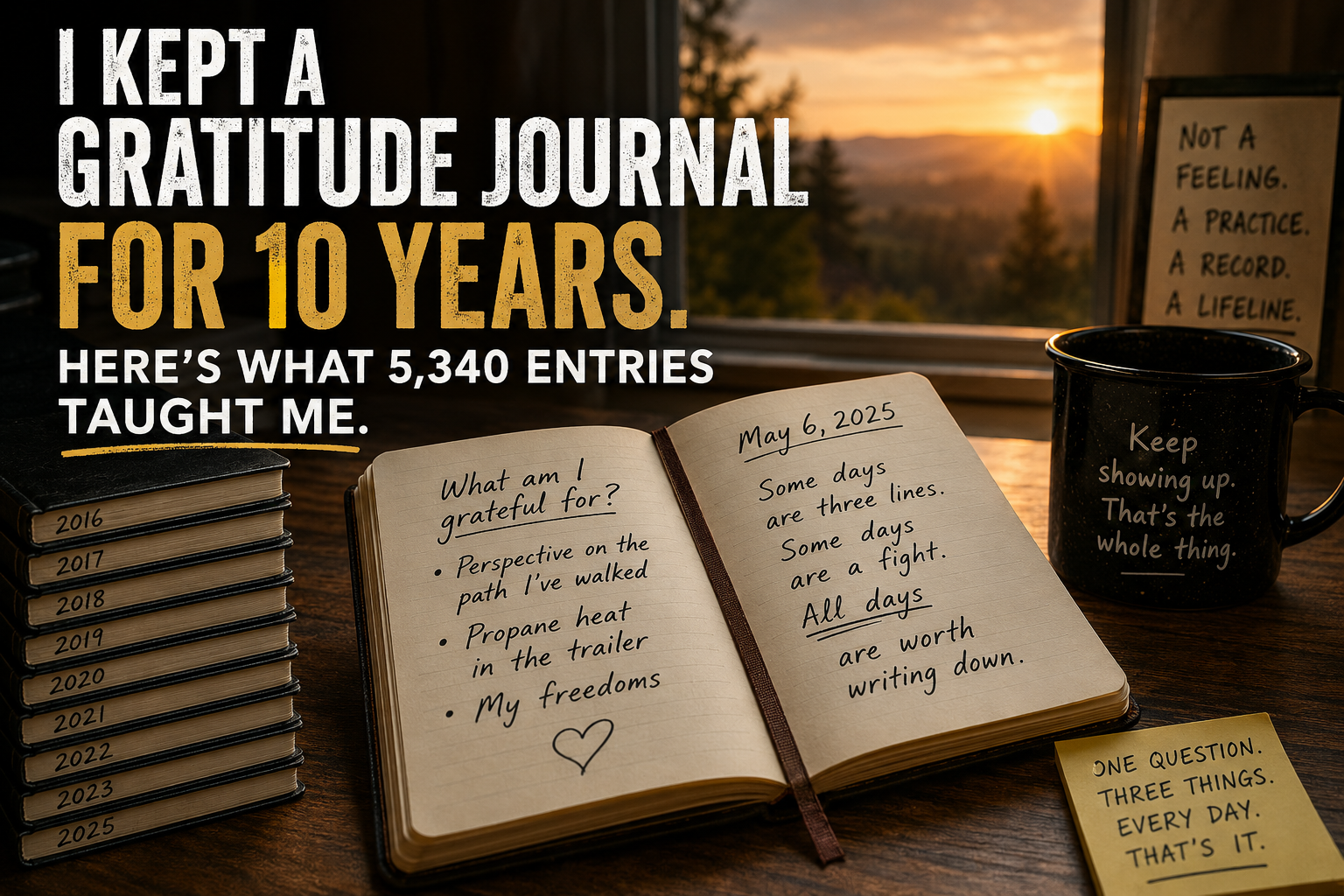
I started a gratitude practice on September 29, 2016. As of this spring, that’s 5,340-plus entries across roughly 10.4 years. It predates the hardest thing that ever happened to me: having a stroke in March 2023. The journal was already more than six years old when that arrived. It kept running straight through it.
So when I talk about gratitude, I’m not describing a mood. I’m describing the one habit in my life that never broke, and what a decade of it taught me about staying upright when everything else falls down.
Key takeaways
- A gratitude practice is one question asked daily: What am I grateful for? Three to five things. Some days, one line. That’s the whole method.
- It lasts because it’s small enough to do on your worst day, not because you feel inspired.
- Specific beats grand. “Propane to heat the trailer” does more than “I’m grateful for warmth.”
- The research is encouraging: regular gratitude is associated with lower stress markers and a slow shift in what your brain notices. It is not magic, and it does not erase hard things.
- The point isn’t to feel better on command. It’s to keep an honest record of what actually mattered.
What a gratitude practice actually is
A gratitude practice is simple: you note what you’re grateful for, on purpose, on a schedule. One question, asked every day. What am I grateful for?
I write it in my morning note. Three to five items most days. Sometimes one. Sometimes a full paragraph when something is sitting on me. There’s no app, no scoring, no system enforcing it. For ten years, nothing external ever required me to do it. That turns out to be the entire point.
Why it survived when nothing else did
I’ve started and quit a lot of things. A YouTube channel. Diets. Whole versions of myself. The gratitude log is the one that held, and I’ve spent a long time asking why.
The answer is unglamorous: the bar stayed low. Three lines on a good day. One line on a day where I’d slept four hours and the world looked gray. I never raised the threshold, so missing once never turned into quitting. Most habit advice obsesses over the 90-day streak. This is the version that lasted through a divorce and a brain injury, because it was always easy enough to do on the worst day.
There’s a quieter mechanism underneath that. I don’t write because I feel grateful. The practice runs first, and the feeling sometimes follows. After ten years it stopped being a task and became part of who I am. The identity produces the feeling, not the other way around. That order matters more than any productivity tip I could hand you.
The hard-day test
The entry I think about most was written on four hours of sleep, in a season when I was living in a travel trailer in Grantville, Georgia, with debt collectors calling and four physical therapists telling me my hand might never come back.
That morning I still wrote three things: perspective on the path I’d walked, propane heat in the trailer, and my freedoms.
None of those are inspirational-poster gratitude. They’re just true. And that’s what the practice is actually for. It is not positive thinking. It is not an attempt to reframe difficulty into something prettier than it was. It’s a measurement device pointed at my own attention, telling me what I still noticed mattered on a day that gave me very little.
On bad days the entries get shorter. A short entry tells you more about the day than a long one ever could. The log doesn’t just record gratitude. It records the weather inside your head, dated and stacked, for years.
What the science says, and what it doesn’t
I’m a writer who survived something, not a neuroscientist, so here’s the careful version.
Gratitude research, including work summarized by neuroscientist Andrew Huberman drawing on the Stellar lab, points to a few consistent findings:
- Regular gratitude practice engages brain regions tied to emotional regulation and social connection, and consistent practice appears to produce measurable changes over time.
- It is associated with lower cortisol and reduced inflammatory markers. The anti-stress effect builds over weeks, not minutes.
- The mechanism that matters most is attention. A steady practice trains your brain to notice good signals it would otherwise filter out.
- Writing why you’re grateful, not just what, engages deeper processing and produces a stronger effect.
- Receiving or witnessing genuine gratitude is even more potent than generating your own.
Two honest caveats. First, this is a real effect, not a cure. It did not bring my hand back or make my disability claim move faster. That took two years. Second, the benefit is dose-dependent and slow. It compounds the way the journal compounds: quietly, over a long time, in a way you can’t feel on any single morning.
How to start a gratitude practice that lasts
If you want the version that survives a bad decade, not just a good week:
- Ask one question. What am I grateful for? Write three things. Don’t build a system. The system is the thing that kills it.
- Set the bar embarrassingly low. One line counts. A single word on a bad day is a successful day, not a failed one.
- Be specific. Name the propane heat, the exact text from a friend, the coffee that was still hot. Specific is what your brain can actually feel.
- Add the “why” when you can. Not every day. But when you have an extra sentence, write why it mattered. That’s where the deeper effect lives.
- Attach it to something you already do. Mine rides on my morning note. Yours can ride on your first coffee or the last minute before sleep.
- Let it be boring. It is not supposed to move you. It’s supposed to be there. Ten years of boring is the whole prize.
What ten years actually gave me
Not constant happiness. I want to be clear about that. The practice ran straight through the worst stretch of my life and did not make that stretch feel good.
What it gave me was a baseline. A fixed point. On the mornings when I couldn’t tell whether I was making any progress at all, there was still a record, in my own hand, of what I’d noticed across thousands of days. It’s the strongest proof I have that I can keep a promise to myself with no one watching.
That’s what I’d want you to take from this. Gratitude isn’t a feeling you have to manufacture. It’s a small, repeatable act of attention. Do the small version on the worst day, and you’ll still have it on the day everything changes.
One thing to try this week: Tonight, write down three things you’re grateful for, and make at least one of them stupidly specific. Then do it again tomorrow. Don’t aim for ten years. Aim for two days in a row.
If you want that same “small version on the worst day” built into a structure made for recovery, it’s the idea behind One Day Forward, the printable journal I put together — no streaks to keep, a missed day is just data.
Frequently asked questions
What is a gratitude practice? A gratitude practice is the simple, repeated act of noting what you’re grateful for, usually by writing a few things down each day. At its most basic it’s one question asked daily: What am I grateful for? It does not require an app, a special journal, or a good mood.
Does keeping a gratitude journal actually work? Yes, with caveats. Research links regular gratitude practice to lower stress markers and a measurable shift in what your brain notices over time. It works best as a slow, consistent habit rather than a one-time fix, and it reduces difficulty rather than erasing it.
How do you start a gratitude practice? Ask one question each day: What am I grateful for? Write three things. Keep the bar low enough that you can do it on your worst day, be specific, and attach it to a habit you already have, like morning coffee or bedtime.
How long does it take to see benefits from gratitude? Research suggests benefits build over weeks of consistent practice, not in a single session. The deeper return, a steadier baseline and a record you can trust, comes over months and years.
Can gratitude help after trauma or a major life disruption? It can help, but it isn’t a replacement for treatment or support. For me, a gratitude practice was a baseline that held through a stroke and the hardest year of my life. It didn’t fix those things. It gave me a fixed point while I worked on them.
Blake Murphy is the author of Still Here: And Still Choosing, a memoir about surviving a stroke and choosing to keep going. It’s available now on Amazon. If this helped, send it to one person who needs a reason to keep going. More at blakemurphyofficial.com.

Leave a Reply