
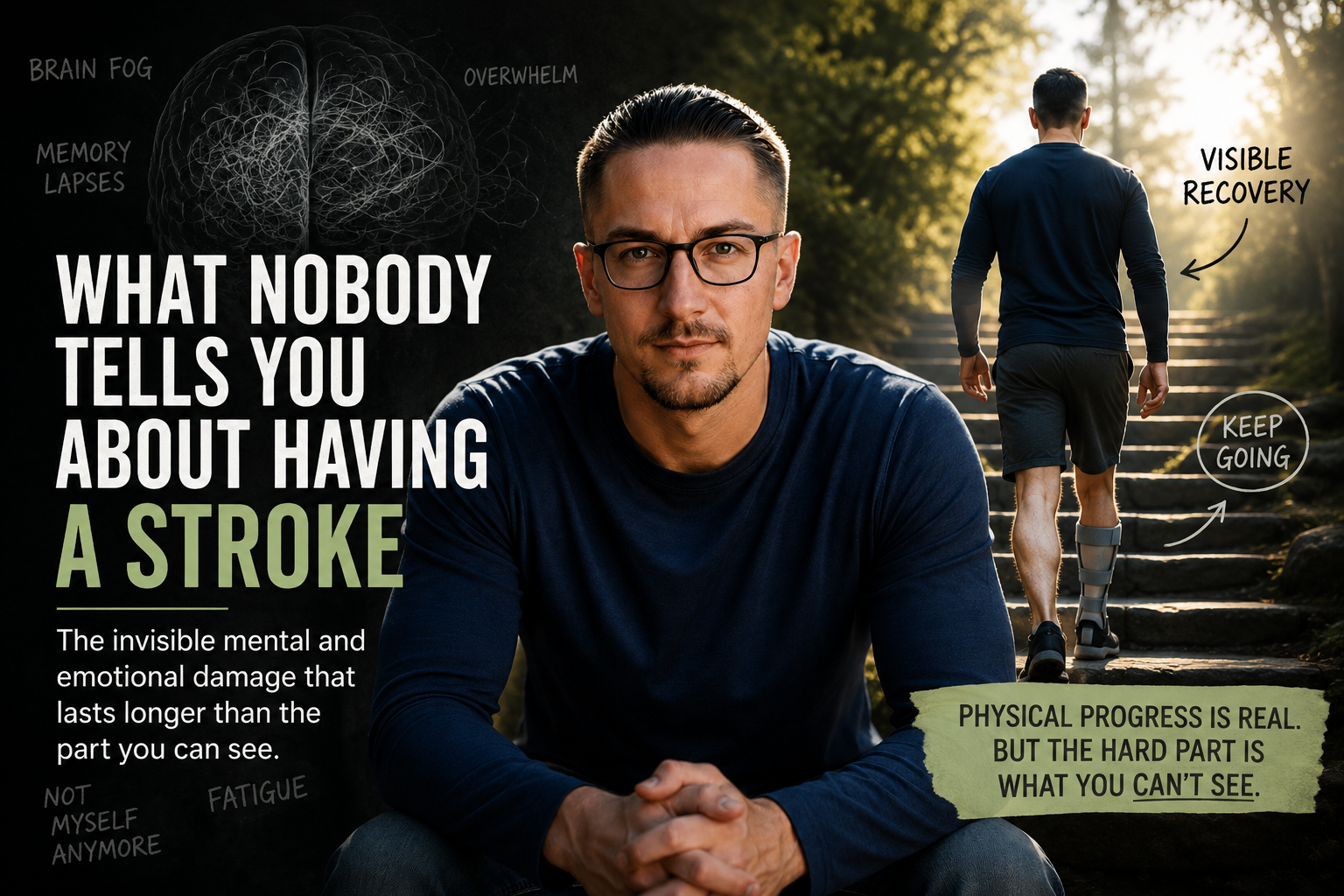
The short answer: What nobody tells you about having a stroke is how much it affects your mental health. Physical recovery is visible. You can see the limp. You can see someone walking again. The cognitive and emotional damage is invisible, and it lasts longer than the part you can point to. You can be making real progress on the outside while your brain is still misfiring on the inside. That gap is the hardest part of recovery, and almost nobody warns you about it.
The visible part is the easy part
When people ask how I am doing, they usually mean my body.
Can I walk. Can I lift. Am I back at the gym.
Those questions have answers. I move better than I did six months ago. I can do things now that I could not do a year ago. On a chart, recovery looks linear.
The chart is lying.
The part nobody sees is what’s happening between my ears: processing speed, memory, task switching. There’s the fog that shows up at 2 p.m. for no reason, and the appointment you were sure you’d written down but hadn’t.
That part does not show up in a discharge summary. It shows up in your life.
What is actually happening in your brain
A stroke is a brain injury. That sentence sounds obvious until you live it.
When blood flow gets cut off, the cells in that area die. The brain rewires itself around the damage. That rewiring is called neuroplasticity. It is what makes recovery possible. It is also what makes recovery messy.
The connections that get rebuilt are not the same connections you had before. Some come back almost normal, others are slower, and a few never return the way they were. As a result, you end up with a brain that works, but works differently.
What This Means in Daily Life
A few things this means in practice:
Processing speed drops. Tasks that used to be automatic now require active attention. Reading a paragraph and actually retaining it takes more effort than it used to. So does following a conversation with two people talking at once.
Working memory gets thin. You can hold fewer things in your head at the same time. Put your phone down, and you’ll forget you put it down. Walk into a room, and the reason you walked in is already gone.
Task switching gets expensive. Every time you change tasks, your brain pays a tax. After a stroke, the tax goes up. Switching between email, a phone call, and a notification feels like running a small marathon.
Executive function gets unreliable. Planning, prioritizing, keeping track of appointments. These are all run by the prefrontal cortex. Stroke survivors often describe a calendar that used to manage itself now requiring constant maintenance.
None of this is laziness, and none of it is a character flaw. Instead, it’s a brain that took a hit and is doing the work to come back.
What Helped Me Cope
One thing that helped me manage sensory overload during recovery — especially when my brain was struggling to filter background noise — was a white noise machine. It gave my nervous system something consistent to anchor to, which made it easier to concentrate and sleep.
For deeper brain support, I also looked into light therapy. The BEACON40 Light Therapy Gamma Lamp uses gamma frequency light that some research suggests may support neural function and cognitive recovery. It became a consistent part of my morning routine.
Some links in this post are affiliate links. If you buy through them, I may earn a small commission at no extra cost to you. I only link to products I have personally used or would use again.
Related: The Weight of Silence: Why Talking About Your Pain Is Not a Weakness.
I keep notes and experiments like this in my AI second brain. The full system is in My Brain Has a Backup.