
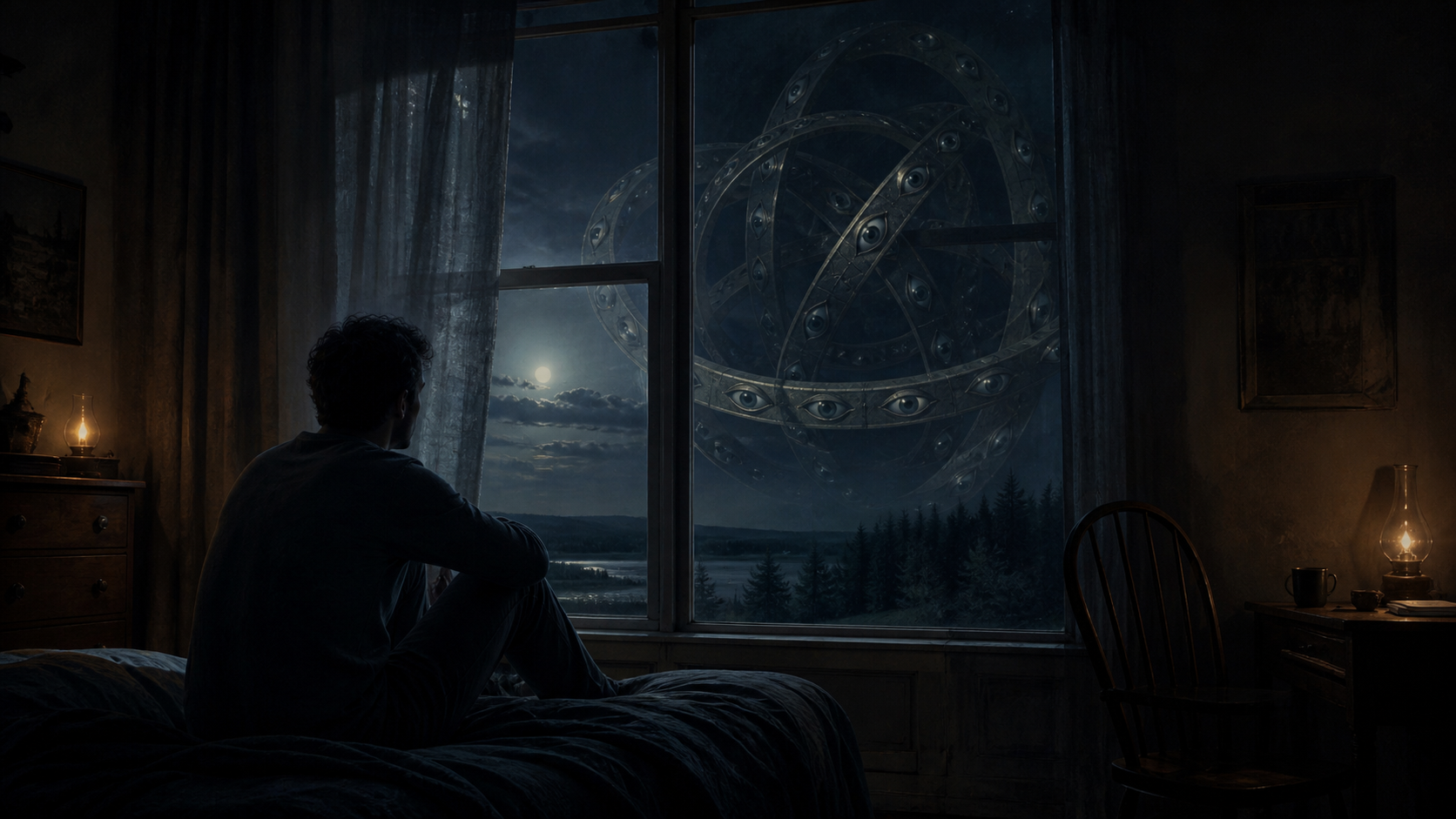
It’s 3 a.m. and I’m awake again. The house is quiet in the specific way it only gets at this hour, when even the appliances seem to be holding their breath. No one needs anything from me right now. There’s nothing to do. So my mind goes where it goes when it has no job, which is sideways.
Tonight it landed on the angels.
Not the soft ones from greeting cards. The strange ones. The descriptions buried in old texts that almost no one reads closely. Wheels within wheels, rims full of eyes all the way around. Beings that are mostly eyes. For most of my life I filed those passages under “weird” and moved on. At 3 a.m., with nothing else competing for the space, the question turned over and showed a different side.
What if the eyes were the point?
Why the angels have eyes
I have a relationship with 3 a.m. now that I didn’t used to have. After the stroke, sleep stopped being a thing that simply happened to me. It became something I negotiate with. Some nights I lose. On those nights I’ve learned not to fight the dark hour but to let it run, because the thoughts that arrive then aren’t the same thoughts I have at noon. They’re slower. They circle. They’re less interested in being useful and more interested in being true.
So I let this one circle.
The thing that struck me wasn’t religious. I’m not writing a sermon, and I’m not sure what I believe about any of it. What caught me was the design choice. If you were an ancient person trying to describe the highest, closest thing to the divine you could imagine, you’d reach for the most impressive material you knew. Gold. Fire. Wings. Light too bright to look at. Instead, again and again, the texts reach for eyes. The closest beings to the center aren’t the strongest or the brightest. They’re the ones that see the most.
That’s a strange thing to land on by accident.
Does watching change what’s there?
The short answer is yes, but not the way people usually mean it.
Here’s where my mind went next, and this is the part I can’t fully shake. In physics there is a small, stubborn fact that has bothered serious people for a hundred years. At the smallest scales, a thing doesn’t seem to settle into one definite state until it is measured. Before the measurement it lives as a spread of possibilities. After, it is one thing, in one place, with one value. The act of looking, of interacting, of pulling information out, appears to change what is there.
I want to be careful here, because this idea gets abused constantly. The “observer” in those experiments isn’t a conscious mind sending out magic attention. It’s a measuring device, an interaction, a physical exchange of information. The universe isn’t waiting for you to feel something. So I’m not claiming that thinking hard at a particle rearranges it. That’s the kind of overreach that makes the whole conversation embarrassing.
But strip the mysticism off and a quieter fact remains. Observation is not free. To observe something, you have to interact with it, and the interaction leaves a mark. You can’t watch without touching. There’s no window in nature that lets you see a thing without, in some small way, changing it.
Sit with that for a second. It applies far past physics.
What happens when you know you’re being watched
Think about the last time you knew you were being watched. Not paranoid, just aware. A camera in the corner. A coach on the sideline. A parent in the doorway. You didn’t become a different person, but you became a slightly more deliberate version of the one you already were. You stood up a little straighter. You finished the rep with cleaner form. The observation didn’t control you. It refined you.
I noticed this most clearly in physical therapy. Alone, I cut corners without meaning to. The brain is efficient and a little dishonest, and it’ll quietly lower the bar when no one is keeping score. But when the therapist watched, the same exercise became real. Not because I was performing. Because being seen closed the gap between what I intended to do and what I actually did.
The eyes weren’t judging me. The eyes were holding me to the thing I already wanted.
What you attend to grows
So here’s the reframe that kept me up.
We tend to imagine that reality is fixed and that watching it is a passive act, like reading a number off a dial that was already set. The dial was going to say what it says whether or not anyone looked. Most of how we move through life assumes this. We think our attention is a flashlight. It lands on things that were fully themselves before we got there and will be fully themselves after we leave.
I’m no longer sure that’s right, at any scale.
What you attend to grows. What you stop watching drifts. A relationship you stop observing closely doesn’t stay frozen at the last good moment. It moves, usually toward neglect. A skill you stop measuring degrades quietly while you assume it’s holding. A life you stop examining doesn’t pause politely and wait for you to check back in. It keeps running, and it runs toward whatever it is pointed at, which is rarely the thing you’d have chosen on purpose.
Observation, it turns out, is one of the few real powers we have. Not because looking at something rewrites it by force, but because sustained attention is how anything gets held to a standard, including ourselves.
None of this means being strong all the time. It means building a system that runs your life so the important things get watched even on the days you can’t watch them yourself.
You become what you keep your eyes on
The takeaway is small, and I think it’s true.
That’s not a motivational line. It’s closer to a mechanical one. Attention is the interaction. Where it lands, things sharpen. Where it leaves, things blur and drift. The angels covered in eyes aren’t powerful because they can act on the world. They’re powerful because nothing in front of them goes unobserved, and what is observed can’t quietly fall apart.
I don’t know if that’s what those old writers meant. They almost certainly weren’t thinking about quantum measurement or recovery or the slow rot of an unexamined habit. But intuitions hide inside images, and the image they kept reaching for wasn’t a fist. It was an eye. People who had no instruments and no theory still seemed to sense that the closest thing to the sacred wasn’t the thing that could change reality by force. It was the thing that could see all of it without looking away.
What am I willing to keep watching?
If any of this holds, it changes one ordinary decision, which is where I’ll leave it.
The question stops being “what do I want to do today” and becomes what I’m willing to keep watching. Because the watching is the part that lasts. The body I’m rebuilding, the work I’m trying to make real, the people I’d rather not let drift, these don’t need my force nearly as much as they need my attention, returned to them again and again, especially on the days I’d rather not look.
So I built a morning routine that works for those days. It watches the first hour so I don’t have to.
It’s almost 4 a.m. now. I’m not sure I’ve proven anything. I have a hunch dressed up as a thought, which is most of what 3 a.m. produces.
But I’ll ask you the thing I’m holding, and then I’ll try to sleep.
What in your life have you stopped watching, and what do you think it has been doing while you weren’t looking?
Leave a Reply