
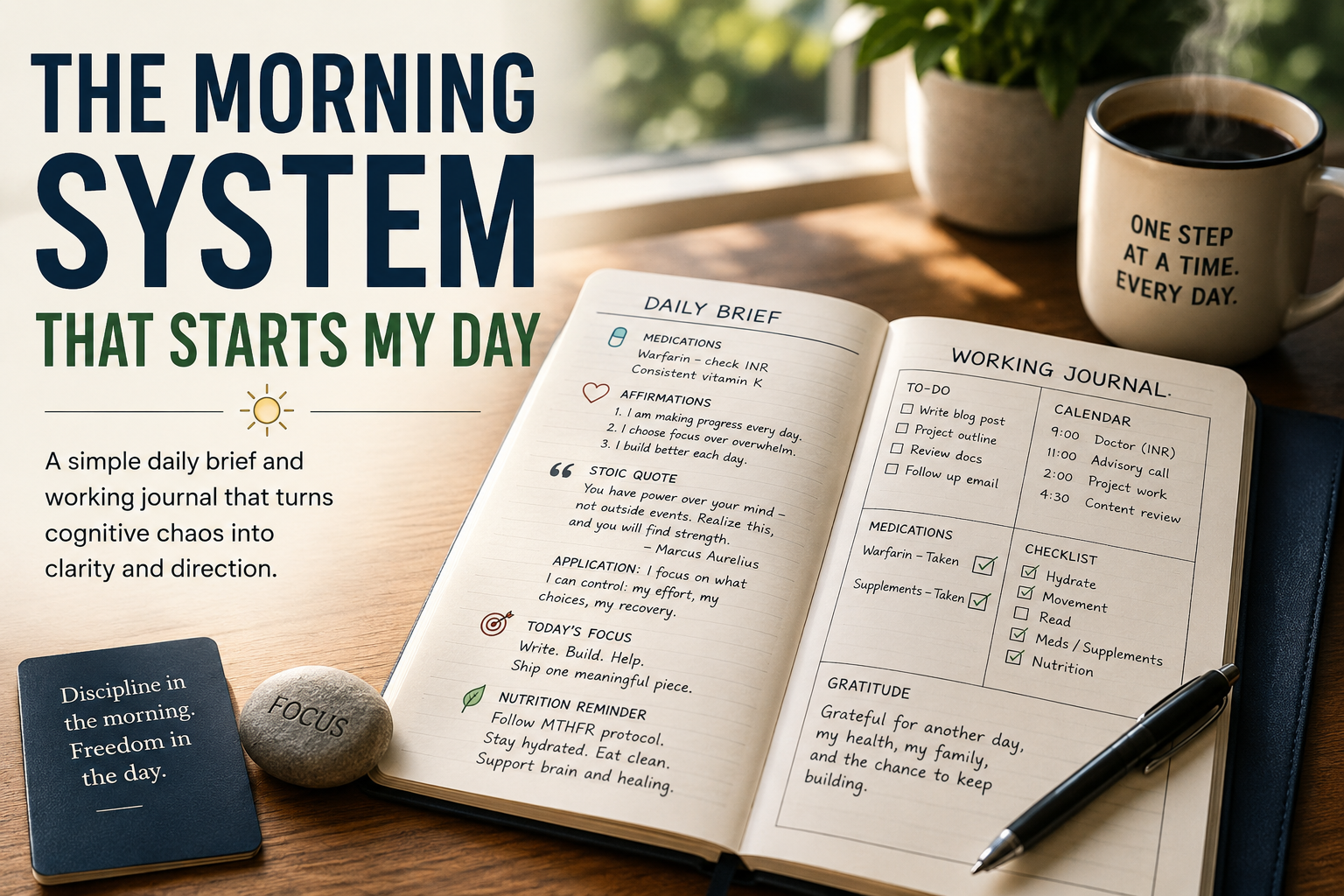
The short answer: My morning system for stroke recovery exists because, after my stroke, mornings became a cognitive obstacle course. Before I could do anything meaningful, I had to reconstruct where I was, remember what mattered, and convince myself I was capable of moving forward. I don’t solve that with willpower or a clever phrase. I solve it with automation. Every morning a daily brief and a working journal entry are waiting for me. The brief points me in a direction. The journal runs the day. Here is what that looks like.
The Part Nobody Tells You About Stroke Recovery
The stroke didn’t just affect my body. It hit the infrastructure.
Working memory. The ability to hold a thought while executing a task. The mental bandwidth to load context from yesterday and carry it forward into today without losing something in the transfer.
These are the deficits that don’t show up in a discharge folder. They don’t look dramatic. From the outside, you’re fine. From the inside, starting a morning feels like booting up a computer that crashed overnight and isn’t sure which files made it.
I spent a long time building workarounds. Notebooks. Checklists. Reminders. These helped. But they had a ceiling. The system could hold information. It couldn’t hold context. And context is the difference between having notes and knowing what to do with them.
What I Actually Do
Two things run my morning, and they do different jobs.
The Daily Brief
The first is a daily brief, built overnight. I glance at it to get a sense of direction: what’s going on, the weather, any news I need to be aware of, and anything my advisors need to flag for me. A few minutes of reading tells me what kind of day I’m walking into. Specifically, it covers:
- My medications and what to watch for. I take Warfarin, which requires INR monitoring and consistent vitamin K intake.
- Three affirmations grounded in where I actually am, not where I want to be.
- A Stoic quote and a personal application to my recovery, not a generic motivational line.
- My project focus for the day, based on what matters most right now.
- Nutrition reminders specific to my MTHFR (gene mutation) protocol.
The Working Journal
The brief points me. The journal, however, runs the day.
I want to be clear about what I mean by journal, because the word carries baggage. This is not a feelings diary. It is not “here is who was unfair to me today.” Instead, it is a professional working log. An automated entry is created for me each morning, and I am in and out of it all day, capturing anything I need to hold onto: tasks, appointments, details for future projects, decisions, things I can’t afford to let slip. It starts the day with structure already in place:
- My to-do list for the day
- My calendar
- Whether I’ve taken my medications
- My checklist
- Gratitude
The gratitude line is the oldest part of this. I’ve been recording gratitude every day for over ten years, long before the stroke. After the stroke, the journal grew to hold everything else: tasks, appointments, project notes, the logistics my memory can no longer be trusted with. But the gratitude stayed. I keep it because it does something the rest of the log can’t. It is hard to feel sad when you’re grateful. Hard to feel angry. Gratitude crowds the other emotions out, and on a heavy morning that matters more than any task list.
Because my working memory took a hit, anything that isn’t written down is effectively gone. The journal is where it goes. It is the difference between trusting my memory to carry context across the day and trusting a system that doesn’t crash. By the time I close it at night, it is a record of what actually happened and what the next day needs to know.
Why This Morning System for Stroke Recovery Works
My morning system for stroke recovery is built around one hard truth. The problem with standard productivity advice is that it assumes a baseline that stroke survivors don’t have.
“Just pick your most important task” assumes you can load and compare all your options with low friction. For me, that comparison step is the expensive one. It burns cognitive fuel before the day has started.
What the automated entry does is take that step off my plate. The options, the calendar, the open loops, the question of whether I took my meds: all of it is already laid out. As a result, I’m not reconstructing the day. I’m reacting to a day that’s already been assembled.
The result isn’t a pile of tasks I have to sort. It’s a foothold.
A foothold is all a hard morning needs.
How to Use This Today
You do not need to have had a stroke to use this. Anyone dealing with cognitive fatigue, executive dysfunction, depression, chronic illness, or just too many competing priorities can adapt it.
The principle is simple: don’t start your morning by building the day from scratch. Instead, build a template once, then let it greet you already filled in. The structure I use has five parts you can copy:
- To-do. The handful of things that actually matter today, pulled in ahead of time, not brainstormed at 7 a.m.
- Calendar. What’s already committed, so you’re not surprised by it.
- Medication or health check. A yes or no you answer once, so it stops living in your head.
- A checklist. The repeatable basics you don’t want to re-decide every day.
- Gratitude. One line. It resets the tone before the to-do list sets the pace.
You can have an AI assistant generate this for you each morning if you give it persistent context about your life, or you can keep a fixed template you open and fill in by hand. Either way, treat it as a living document, not a morning ritual you close and forget. The value compounds when you return to it through the day and log what you’d otherwise lose. Ultimately, the automation isn’t the point. Removing the daily cost of reconstruction is the point.
What It Is Not
This is not a replacement for medical care, therapy, or a real support system.
Because of what the stroke did, I take medications every morning. My doctors are involved. Protocols are in place. This system exists inside a larger framework of recovery, not instead of it.
What it does is fill the gap that medicine doesn’t reach: the daily cognitive overhead of showing up and starting.
Medication keeps my blood thin. The morning entry helps me function. Those are different jobs.
In Short
- A morning system for stroke recovery turns chaos into direction. After a stroke, starting the day became a cognitive task, not just a time management one.
- The journal entry is the working document I run the day from. It is a professional log, not a feelings diary, and I’m in and out of it all day capturing tasks, appointments, and anything I need to remember.
- A separate overnight brief is a quick glance for direction: weather, news, advisor notes, plus medication notes, affirmations, a Stoic application, project focus, and nutrition reminders.
- This works because it removes the reconstruction step, which is where the cognitive overhead lives.
- You don’t need to be a stroke survivor to use it. Anyone with cognitive fatigue or decision overload can adapt the same structure.
FAQ
What is morning cognitive fog after a stroke?
Cognitive fog after stroke refers to difficulty with mental clarity, memory retrieval, and processing speed, especially in the morning when the brain is moving from a sleep state to active function. It is common after neurological events and tends to improve over time, but it can persist.
Can AI actually help with stroke recovery?
AI doesn’t treat stroke. However, it can reduce the cognitive overhead of daily functioning by holding context, surfacing relevant information, and reducing the number of decisions required to start a task. That’s what a cognitive prosthetic does.
Does this require a specific AI tool?
No. You can build the automated entry with whatever assistant you use, or keep a fixed template you fill in by hand. The quality improves when the system has persistent context about your situation, but the structure works on its own.
What if I can’t fill in the whole entry on a hard morning?
Start with one line. Even answering “did I take my meds” and writing a single gratitude note is enough to break the stall. The structure is there to be leaned on, not completed perfectly.
Is this the same as journaling?
Not in the way most people mean it. This isn’t a feelings diary or emotional processing. Instead, it is a professional working log: a daily operating sheet I return to all day to capture tasks, appointments, decisions, and details I need for future work. Traditional journaling is open-ended output. This is navigation and memory.
You can get part of my own personal journal template here.

Leave a Reply