
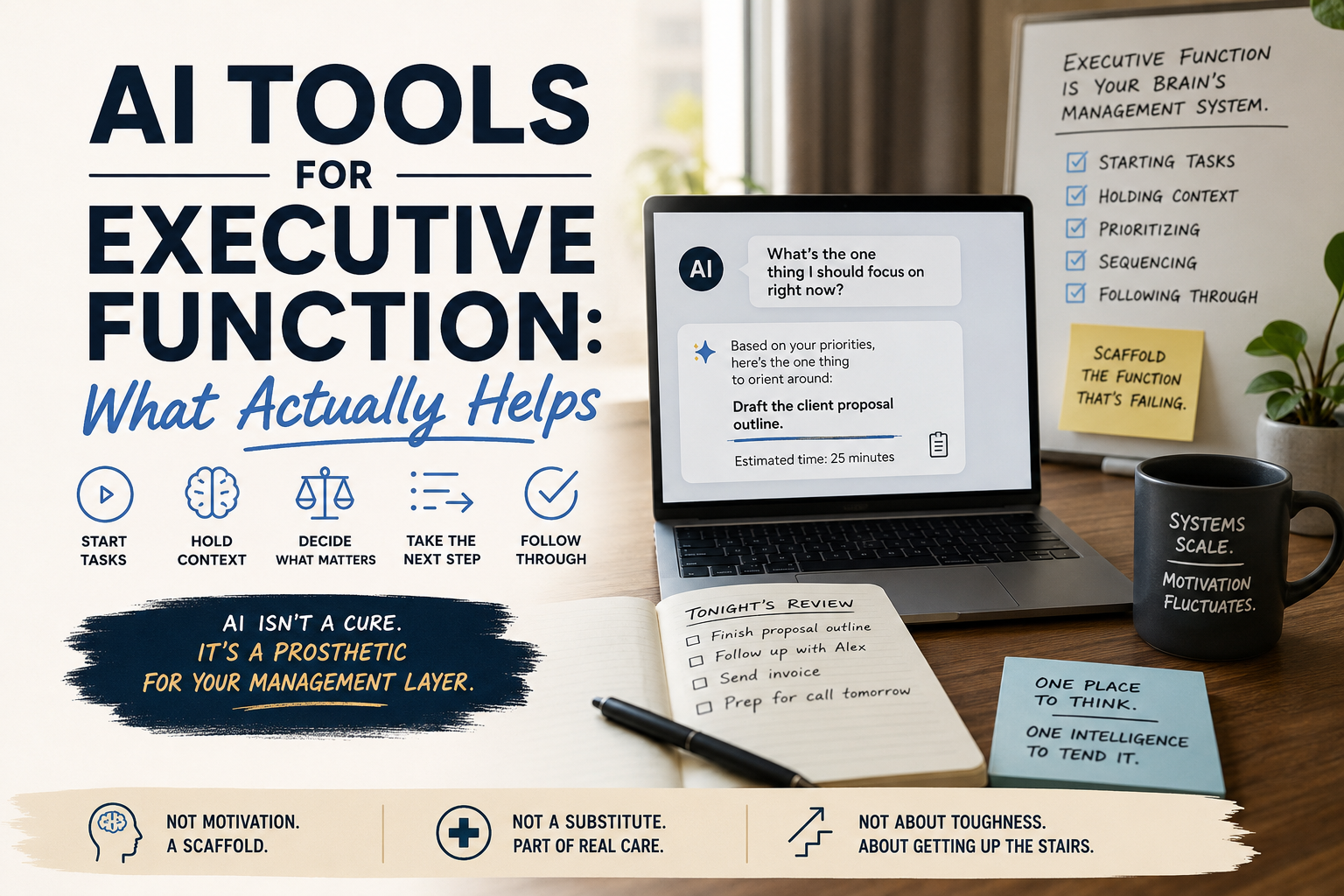
The short answer: AI tools help executive function by doing the parts your brain struggles with most: starting tasks, holding context, and deciding what matters. The best setup is a general AI assistant like Claude or ChatGPT plus one place to store your notes. AI does not cure executive dysfunction. It scaffolds it, the way a ramp does not heal a leg but still gets you up the stairs. I rely on this every day since my stroke.
What Executive Function Actually Is
Executive function is the brain’s management system. It runs the work behind your work: planning, starting tasks, holding information in mind, switching between things, prioritizing, and following through.
When it is working, you do not notice it. When it is not, the breakdown is invisible from the outside. You look fine. Inside, the simplest task stalls because the part that organizes action is running with a lag.
Executive dysfunction is the term for that breakdown. It shows up after stroke and other neurological events, and also in ADHD, burnout, depression, long COVID, and chronic illness. Different causes, same daily friction: knowing what to do and being unable to get the machine to start.
Why AI Works as a Scaffold
Standard productivity advice assumes a baseline that a lot of us do not have. “Just pick your most important task” assumes the comparing step is cheap. For me, that step is the expensive one. It burns fuel before the day starts.
AI helps because it can take over the specific sub-functions that are failing, on demand, without judgment. It is not motivation. It is a prosthetic for the management layer. You describe your state, it carries the load you cannot carry right now, and you keep moving.
A clean way to say it: motivation is unreliable, and systems are scalable. A scaffold you can lean on every day beats a push you have to summon.
The Executive-Function Tasks AI Handles Best
Executive function is not one thing, so match the tool to the specific failure.
Task initiation (getting started). This is the most common stall. Instead of facing a blank task, I ask AI for one foothold: “I am struggling to start. I feel scattered. Based on my priorities, give me the one thing to orient around, not a list.” One thing is something a stuck brain can act on.
Working memory (holding context). Returning to a project after a gap and rebuilding where you were is costly. I keep my work in a notes vault and ask, “Where did I leave things on this project?” The summary comes back in plain language in two minutes, instead of twenty minutes of reconstruction.
Prioritization (deciding what matters). When everything feels equally urgent, I describe the options and ask AI to weigh them against what I said matters this season. Offloading the comparison is often the whole unlock.
Planning and sequencing (breaking it down). A task that feels like a wall is usually a task with no first step. I ask AI to break it into the smallest next action. Not the plan. The next move.
Follow-through (closing loops). A nightly review pulls from my calendar, email, and notes, then flags the open loops I would otherwise drop. The system remembers what my brain no longer reliably holds.
The AI Tools for Executive Function I Actually Use
I keep my stack small on purpose. More tools mean more decisions, and decisions are the scarce resource.

A general AI assistant. I use Claude because it holds long context well. ChatGPT and Gemini also work. This is the layer that starts, summarizes, and prioritizes.
One notes store. I use Obsidian, a free, local, plain-text app. It is where context lives so the AI has something durable to read from. Notion or Apple Notes are fine substitutes.
That is it. The win is not a clever app. It is one place to think and one intelligence to tend it. Purpose-built ADHD and focus apps exist and help some people, but the general assistant plus a store covers more ground for less setup.
What AI Cannot Do
This is a scaffold, not a treatment. AI does not replace medical care, therapy, medication, or rest. I take medication every morning because of what the stroke did, and I have doctors and protocols. The AI sits inside that larger system, not instead of it.
It also will not fix a task that needs to wait. Sometimes the honest diagnosis is depletion, and the right move is to stop, not to push. AI can help you name that too, if you ask it to tell you the truth instead of a plan.
Quick Summary
- AI tools for executive function scaffold the brain’s management system: starting, holding context, prioritizing, sequencing, following through.
- AI scaffolds the specific function that is failing rather than treating the cause.
- Best setup: one general AI assistant plus one notes store.
- Ask for one thing, not a list, when initiation is the problem.
- It is a prosthetic, not a cure. Keep it inside real medical and personal support.
FAQ
What are the best AI tools for executive function?
A general AI assistant (Claude, ChatGPT, or Gemini) paired with one notes app (Obsidian, Notion, or Apple Notes) covers the most ground. The assistant handles starting, summarizing, and prioritizing; the notes app gives it durable context to work from.
Can AI help with executive dysfunction from ADHD?
Yes. Executive dysfunction looks similar across causes, including ADHD, so the same scaffolds apply: reduce task-initiation cost, offload working memory, and break tasks into a single next step. AI supports those functions but does not replace diagnosis or treatment.
How does AI help you start a task you keep avoiding?
Ask it to name the blocker instead of pushing you. A prompt like “I keep avoiding this and I am not sure if it is fear, unclear scope, or depletion. Ask me one question to figure out which” usually surfaces the real cause, and naming it tends to unlock movement.
Is using AI for executive function just a crutch?
A crutch is the right tool when something is hurt. The goal is function, not toughness. Glasses, calendars, and ramps are all external aids we never call cheating. An AI scaffold is the same idea applied to the brain’s management layer.
Does this replace therapy or medication?
No. It reduces the daily cognitive overhead of functioning, which is a different job from treatment. Keep AI as a support inside real medical care, not as a substitute for it.
This post is part of the system I describe in My Brain Has a Backup, the AI second brain that runs my day.