
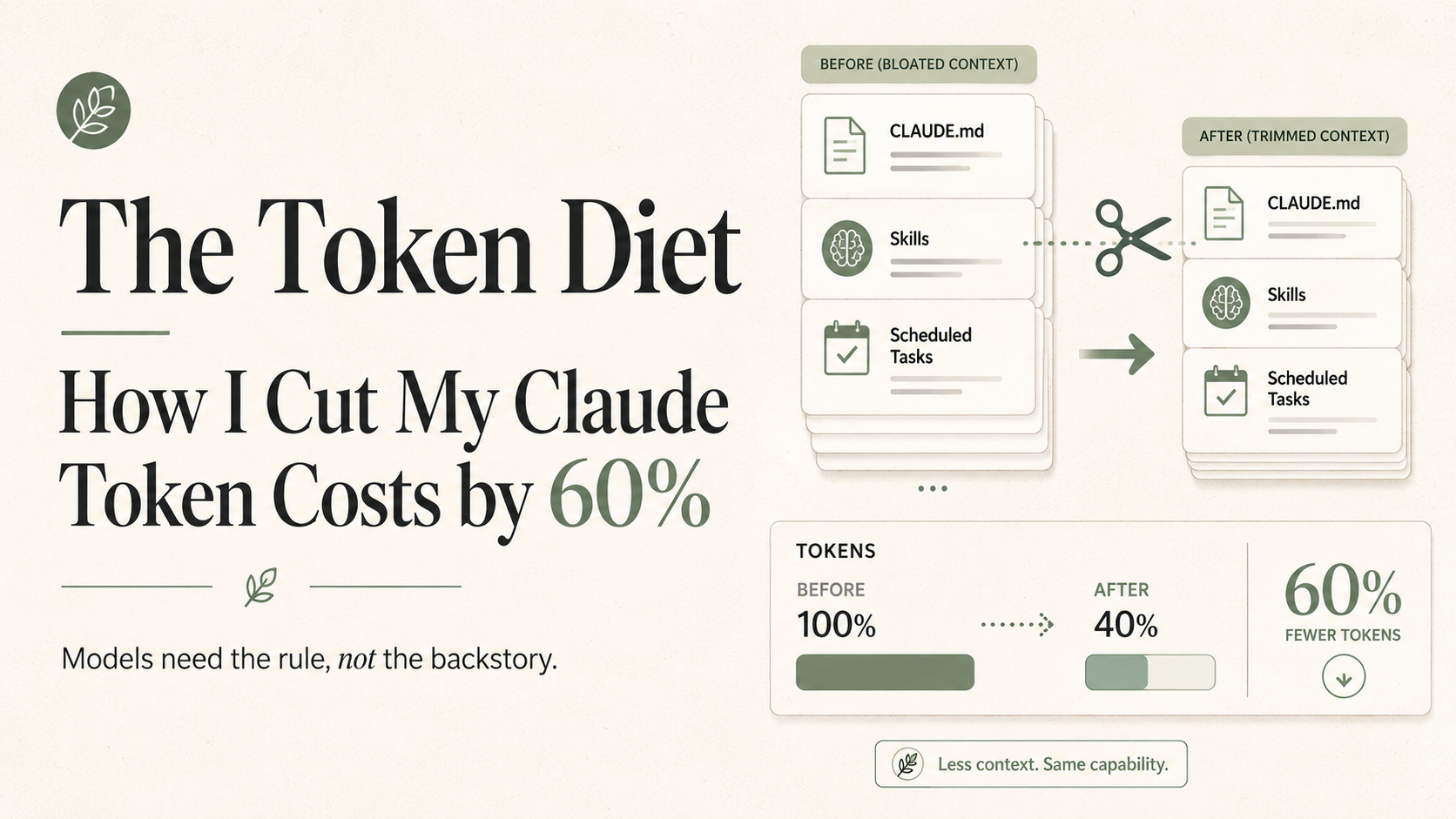
The short answer: Claude re-reads your memory file, your skill descriptions, and your scheduled-task list before answering every single message. Most of that text is bloat you wrote once and never trimmed. Cut the bloat and you cut your Claude token costs, with zero loss of capability. I trimmed my own setup by roughly 60% in an afternoon.
A token diet is the practice of trimming the context an AI assistant loads on every session so that every line it reads earns its place.
Hey, Blake here.
If you have read anything on this site, you know my second brain is not a hobby. After my stroke, an Obsidian vault of 4,000+ notes and a Claude workflow became the backup system my memory needed. Claude runs my morning brief, my nightly reset, my filing, my reminders. It is a daily driver in the most literal sense.
Which is exactly how I ended up paying what I now call the invisible tax.
The invisible tax on every message
Here is the part most people miss about running Claude seriously: you do not just pay for the questions you ask. Before Claude answers anything, it reads its standing context. That includes:
- Your memory file (CLAUDE.md). Loaded into every session, no exceptions.
- Your skill descriptions. Every custom skill announces itself to every session, whether it fires or not.
- Your scheduled-task list. If you run recurring jobs, their descriptions get re-read constantly.
Every one of those words adds to your Claude token costs. Every message, every day. None of it shows up as a line item, which is why nobody trims it.
What I found in my own setup
One afternoon I audited mine. I had 35 scheduled tasks, and the descriptions read like diary entries. Schedule details the scheduler already displayed. Notes about which task absorbed which older task. Little pep-talk phrases like “critical” and “must-have” that helped no one, least of all the model.
One pass of trimming cut my Claude token costs by roughly 60%. Not one workflow broke. The model tags stayed. The retired-task markers stayed. The one warning that says “do not delete this file” stayed. Everything that changed behavior survived; everything that was history, rationale, or decoration went.
Then I did the same for my memory file and my skills, and the pattern held: most standing context is backstory, and the model does not need the backstory. It needs the rule.
If you are the kind of person who wants to build a second brain with AI, this matters double. The whole point of the system is that it runs constantly in the background. Constant background operation on a bloated context is a subscription to waste.
The fix: four prompts for Claude Token Costs
I turned the cleanup into four copy-paste prompts, because I never want to reinvent it and neither should you:
- Scheduled Task Trim. Cuts task descriptions to the bone while preserving the flags that route work.
- The CLAUDE.md Diet. Puts your memory file on a diet with an approval gate, so nothing is lost without your sign-off.
- Skills Audit. Trims always-loaded skill descriptions without breaking the trigger phrases that make skills fire.
- The Convergence Loop. A master prompt that runs all three on repeat until a full pass finds almost nothing left to cut, then stops on its own.
The guardrails are the real product. Anyone can tell an AI “make this shorter.” The hard part is trimming aggressively without deleting the one line that keeps your medication reminder accurate or your routing rules intact. Each prompt draws that line explicitly: cut history, rationale, and duplication; keep rules, flags, triggers, and paths.
Try this one free
Here is the core of the first prompt. Run it today if you use scheduled tasks:
Trim all my scheduled-task descriptions to minimize token spend. Target the shortest description that still identifies the task at a glance. Preserve functional flags like model-routing tags and retired markers. Cut schedule details the scheduler already displays, merge history, rationale, and self-praise. Descriptions only. Report count updated, estimated token reduction, and flags preserved.
That single paragraph paid for my afternoon. The full pack adds the other three prompts, the hard rules that make the master loop safe to run unattended, and the reasoning behind each cut, packaged as an 8-page PDF. There is also a dedicated product page with the full breakdown.

Get The Token Diet on Gumroad for $9
Two honest cautions
First, do not chase zero. The goal is context that earns its place, not minimal context. A well-placed rule that prevents one bad output a week pays for its tokens many times over.
Second, bloat is entropy. It comes back. I re-run the master loop monthly, and since Claude can schedule its own tasks, the diet now maintains itself. There is something pleasing about that.
For readers using Claude for focus and working-memory support, the same trim makes responses faster too, and faster matters when attention is the bottleneck. That is a core theme in my work on AI tools for executive function.
Quick summary
- Claude reads your memory file, skill descriptions, and task list before every answer. You pay for all of it, every message.
- Most standing context is history and rationale. Models need the rule, not the backstory.
- One trimming pass cut my scheduled-task overhead by ~60% with zero broken workflows.
- Four prompts automate the cleanup safely: task trim, memory diet, skills audit, and a self-stopping master loop.
- Re-run monthly. Bloat regrows.
FAQ
How do I reduce Claude token costs?
Trim the standing context Claude loads every session: your CLAUDE.md memory file, skill descriptions, and scheduled-task descriptions. Keep rules, flags, and trigger phrases; cut history, rationale, and duplication. My first pass cut roughly 60% of task overhead with no lost capability.
What is a token diet?
A token diet is a systematic trim of the context an AI assistant re-reads on every message, so every line either changes the model’s behavior or gets cut. It lowers cost and speeds up responses without reducing what the assistant can do.
Does trimming CLAUDE.md break anything?
Not if you keep the rules and drop the explanations. The model follows a rule identically with or without its backstory. The risk is deleting anchors other files reference, so check references first and review a diff before saving.
Is this worth it on cheaper models?
The prompts work on any Claude model, but the savings scale with price. On premium models like Fable 5 and Opus, every trimmed token counts double.
If you are still on the fence about Claude itself, this is my referral link. You get a free week, and I get a small usage credit if you end up subscribing: claude.ai referral.