
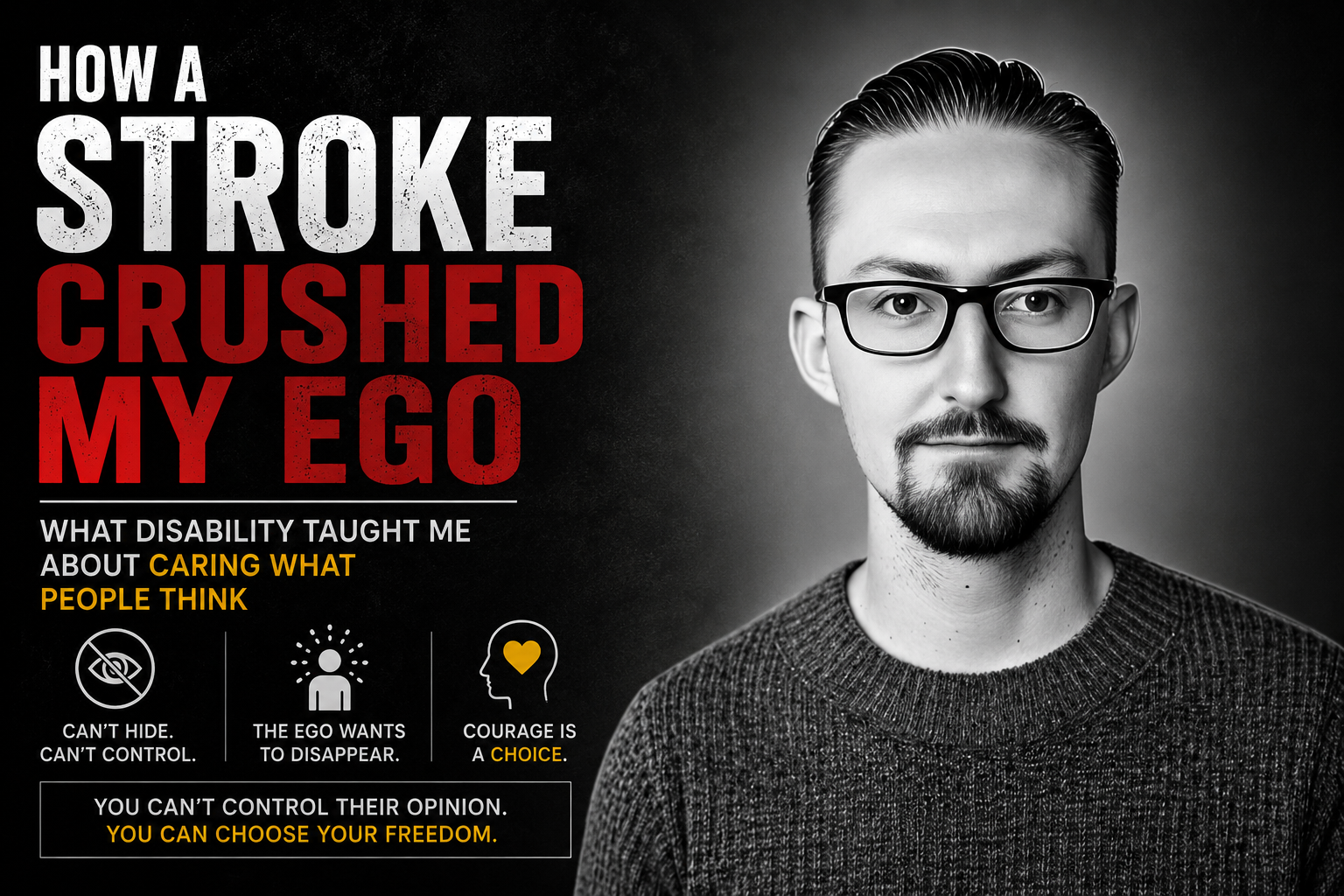
Short answer: A stroke crushes the ego because it removes your ability to hide. You can’t control how you look, how you walk, or how your body sits in a room. Once people are already staring, the fear of being judged stops being theoretical. You either learn to sit inside that discomfort or you stay home for the rest of your life. I picked the first one. A stroke crushed my ego before it did anything else to me.
Before the stroke, I cared too much. After the stroke, I still cared. That was the problem.
Pre-stroke, I worried about what people thought of me like most people do. Mostly small stuff. How I came across in a meeting. What someone said about a post. Whether I sounded smart.
Then I had a stroke at 35. Suddenly half my body did not work the way it used to. I was partially disabled. And the first thing I noticed was that I was still worried about what people thought of me.
That was the part that almost broke me. I had assumed that surviving something serious would automatically reset my priorities. It did not. The ego does not get the memo. You can be standing in a hospital hallway with a curled hand and your first thought is still, Does this make me look weak?
That is when I realized ego is not something you outgrow by accident. You have to walk through it on purpose.
What people don’t tell you about post-stroke bodies
When the body gets injured, it tries to protect itself. For a lot of stroke survivors, this looks like the affected limb curling inward. My hand pulled into a fist. My arm pulled up against my chest. It is a protective posture. The nervous system is trying to keep the injured side close and safe.
The walking part was not so obvious. People might catch it if they looked twice. But the arm was a tell. A quick glance and you could see something was wrong with me.
That is the part the ego cannot negotiate with. You can hide a bad mood. You can hide a bad day. You cannot hide a curled arm. The arm mattered, but a stroke crushed my ego first.
The first reframe: they’re just checking me out
In the early days, I noticed people staring. Grocery stores. Restaurants. Parking lots. I felt the heat rise every time. My first instinct was to look away or cover the arm with the other one.
So I tried a small mental trick.
I told myself, They’re just checking me out.
It was half a joke. But it worked better than I expected. It loosened something. Instead of being the object of pity or curiosity, I made myself the object of attention on my own terms. The joke gave me a half second of room between the stare and my reaction. That half second was the whole game.
Humor is not a cure. It is a doorway. It got me through the first few weeks without isolating.
The second reframe: I’ll probably never see these people again
After a while the joke stopped being necessary. The real shift was simpler.
I started thinking, This is what it is. If I never recover, I have to live with it. If I do recover, I still have to live with it during the recovery. And I’ll probably never see these people again, so what they think actually does not matter.
That sentence is not motivational. It is mechanical. It is just true.
The ego thrives on imagined permanence. It convinces you that the stranger in line behind you is going to remember the way you held a coffee cup. They are not. They will not even remember your face. Most strangers are running their own mental loops about themselves.
Once you internalize that, public space starts to feel different. Less like a stage. More like background.
The third reframe: the body’s job was never to look normal
When my arm finally relaxed after months of physical therapy, it just hung at my side. Like an arm. That felt like a milestone, but the bigger milestone had happened earlier, somewhere on the inside.
I had stopped thinking of my body as a reputation problem.
The body’s job is not to look normal. The body’s job is to stay alive and to carry you through your life. Mine had done that. It had failed in one specific way and adapted in a thousand small ones. Asking it to also be visually unobjectionable to strangers was a tax I had no business charging.
That is when the ego got quiet. A stroke crushed my ego long before it let me walk normally again.
In short
- A stroke does not erase the ego. It puts the ego on display.
- You cannot logic your way out of self-consciousness. You have to sit inside it.
- Reframes work better than affirmations. Try: “They’re just checking me out.” Or: “I’ll never see them again.”
- The body is not a reputation. It is a vehicle.
- Most strangers are too busy thinking about themselves to remember you.
What you can take from this without having a stroke
You do not need a medical event to get the same lesson. You can practice the same reframes in small ways.
Walk into a room and assume no one is paying attention. Most of the time they are not. Wear the shirt you think is too loud. Eat alone at the restaurant. Ask the question you think is stupid. Each of those is a tiny rehearsal for the bigger version, which is what happens when life forces you into visibility you did not choose.
The people who handle a hard event with the most grace tend to be the ones who already practiced being uncomfortable on purpose. They built the muscle in low stakes before they needed it in high stakes.
Start now. Before you have to.
A note on the recovery side
For anyone reading this who is in the early stage after a stroke or another visible injury, the discomfort is real and it is not a character flaw. The feeling of being watched is not paranoia. People do look. The ego flares up because it is trying to keep you safe in a social environment it does not yet trust.
Give it time. Give it reps. The reframes are not lies. They are training wheels. After enough trips out the door, you stop needing them. A stroke crushed my ego on a schedule I did not get to pick, and recovery worked on the same terms.
Physical therapy helped my arm. Time and reps helped my head. Both worked.
FAQ
Does a stroke change your personality?
Sometimes, yes. The stroke itself can affect mood, impulse control, and emotional regulation depending on where the damage is. Beyond that, surviving a stroke tends to change priorities. Smaller things stop feeling like emergencies. What people think of you can shrink fast.
How do you get over being stared at after a stroke?
Two steps. First, accept that it will happen. Second, give your brain a quick reframe so the stare does not control the next ten seconds. “They’re just checking me out” worked for me. “I’ll never see them again” worked even better. Repetition does the rest.
Why does the arm curl up after a stroke?
It’s called spasticity. The brain’s signals to the muscle are disrupted, and the muscle stays in a contracted, protective position. Physical therapy, stretching, and sometimes medication or Botox injections help the muscle release over time. Mine eventually relaxed and now hangs at my side.
Can you actually crush your ego on purpose?
You cannot crush it in one sitting. You can shrink it. Do things that scare you socially. Be visible when you would rather hide. Get comfortable with being seen wrong. Each rep takes a little air out of the ego.
What is the fastest way to stop caring what people think?
Stop trying to be invisible. The ego grows when you give it a job. Take the job away. Show up as you are. Most people are not watching. The ones who are will forget.
Final Thought: How a Stroke Crushed My Ego
The stroke did not give me a new personality. It just stripped the disguise off the old one. Underneath the worry about how I looked was a simpler worry about being seen at all. Once I stopped trying to hide the arm, I stopped trying to hide everything else.
If you are still working on that, you do not need a medical event to get started. You just need one walk outside without checking the mirror first.
That is the work.
I keep notes and experiments like this in my AI second brain. The full system is in My Brain Has a Backup.