
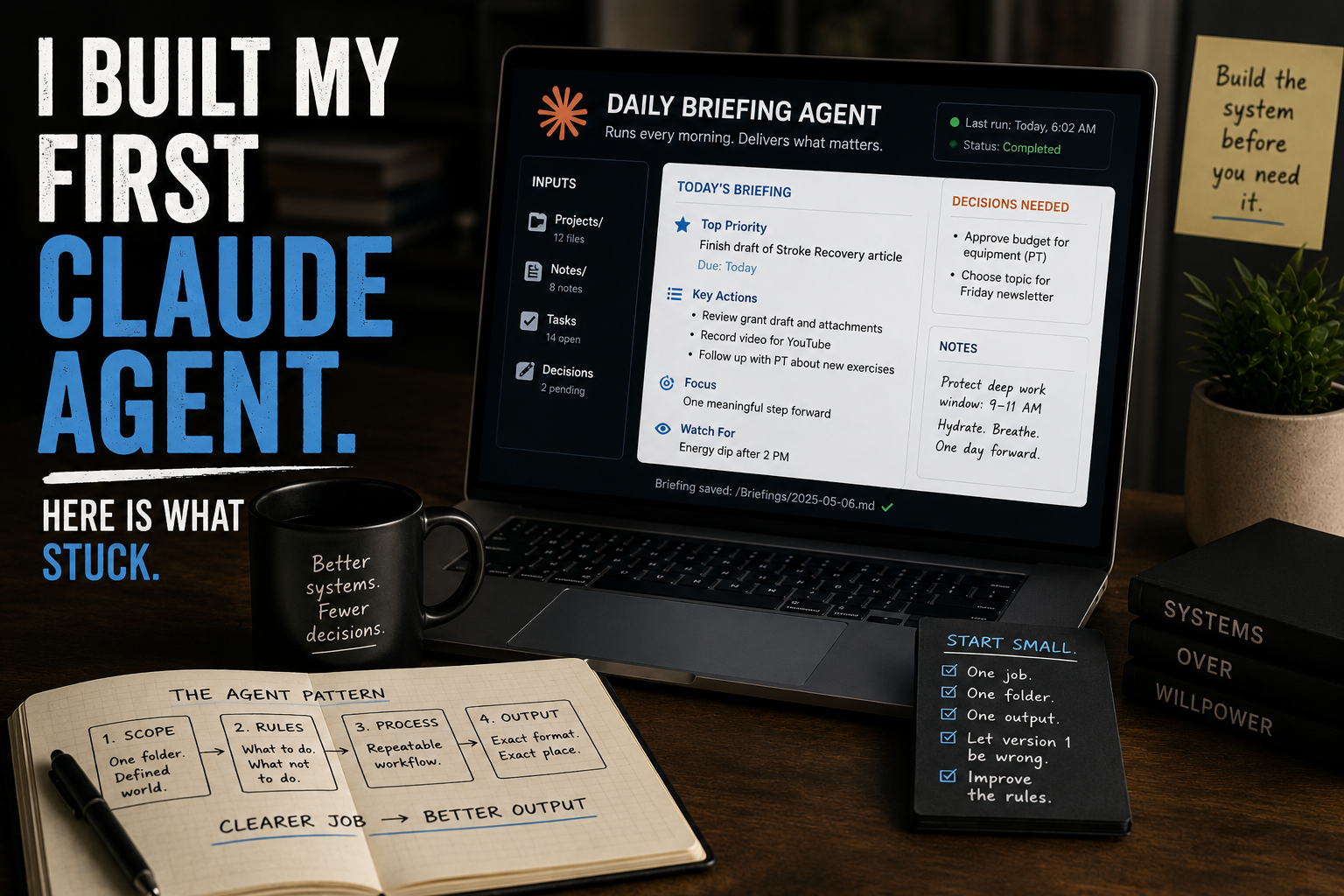
The difference between a chatbot and an AI agent is simple: a chatbot waits for your next message, while an agent keeps working until the job is done. After a year of copy-paste AI sessions, I built one small daily briefing agent with Claude. Here is what actually changed how I work, and the pattern you can use to build your first AI agent.
For about a year, I started every AI session the same way. Open a chat window. Paste in context. Explain who I am, what the project is, what I need. Wait. Copy the answer out. Fix the parts it missed. Close the window.
Then do the whole thing again the next day, from zero.
I told myself this was using AI. It was not. It was doing manual labor with a smarter text box. The machine remembered nothing. I was the memory. I was the file system. I was the project manager. The AI was just the part in the middle that typed fast.
After my stroke, I got sensitive to a specific kind of waste: rebuilding context. Re-explaining things. Re-finding things. My brain already charges me a tax for that. I was not interested in paying it twice, once for myself and once for a tool that was supposed to be helping.
That frustration is what finally pushed me to build an actual agent. Not the science fiction kind. A small, boring one. And the boring one changed how I work more than any model upgrade has.
What Is the Difference Between a Chatbot and an AI Agent?
Here is the distinction that took me embarrassingly long to see. A chatbot waits for your next message. An agent keeps working until the job is done.
That is the whole difference. It is not intelligence. The model behind my old copy-paste sessions and the model behind my agent are the same model. What changed is everything around it.
An agent starts when the AI has a job, a place to work, rules to follow, and a defined output. Read these files. Check the notes. Pull out what matters. Write the report. Save it here. Flag anything that needs my decision.
No magic. A job description.
My First Agent: A Daily Briefing That Builds Itself
The first agent I built was a daily briefing agent. I have written before about what my mornings require and why a document that assembles my day before I wake up matters to me. This is the thing that builds that document.
What it does is plain. It reads my project folder. It checks my notes and tasks. It figures out what actually matters today. It drafts a short briefing, saves it as a clean file, and flags any decision it cannot make for me.
Then it stops. Every morning, same job, no prompting from me.
Why a Stronger AI Model Does Not Fix a Weak Setup
The first version was bad. Not because the model was weak. Because my setup was weak. My files were a mess. My instructions were vague. I had not told it what a good briefing looked like, so it guessed. And an AI that has to guess will guess confidently and wrong.
That was the second thing I learned, and it is the one I would put on a wall: a stronger model does not fix a weak setup.
If the task is vague, the files are messy, the rules are missing, and the output format is unclear, the best model in the world will still produce expensive garbage. People keep waiting for a smarter model. Most of them need a clearer job description.
The Pattern That Fixed It: Scope, Rules, Process, Output
What fixed it was not more AI. It was the kind of work I used to do when I managed actual humans.
I gave it one folder, so it had a defined world instead of my whole digital life. I wrote down the rules in a single file the agent reads first, the way you would write an onboarding doc for a new hire: here is what this project is, here is what I care about, here is what you never touch. I turned the repeatable part of the work into a saved workflow it can run the same way every time, instead of hoping I describe it consistently. And I defined the output exactly: this format, this filename, saved to this place.
Claude has names for all of these pieces now. Project memory files, skills, scheduled tasks, subagents for splitting big jobs, hooks for safety checks. The names matter less than the pattern. Scope, rules, repeatable process, defined output. That pattern is older than AI. It is just management.
The newer models even let you set how hard they think, deeper on judgment calls, faster on routine ones. Useful. But notice what that is: another piece of the job description. You are still just being a clearer boss. That is the whole pattern I would reuse to build your first AI agent from scratch.
The First Version Is Supposed to Be Wrong
The part nobody told me is that the first version is supposed to be wrong.
My briefing agent did not work on day one. It buried the important thing in the third paragraph. It treated stale notes as current. It flagged decisions that did not need me and missed one that did.
Each time, I did not start over. I edited the rules file. One line at a time. Lead with the single most important item. Ignore anything not touched in thirty days. A decision means money, health, or another person. Everything else, just handle.
Within a couple of weeks the briefings stopped needing fixes. Not because the AI got smarter. Because the instructions got truer. The agent was holding up a mirror to how vaguely I had been defining my own mornings. Writing rules for it forced me to decide what actually matters to me, which is a question I had been answering by feel for years.
I did not expect a productivity tool to do that. The system made me articulate my own priorities, in writing, in a file. That document is now one of the more honest things I own.
How to Build Your First AI Agent (Start Small)
I am wary of how this genre usually sounds. Agent content online is mostly screenshots of elaborate pipelines built by people who, as far as I can tell, produce nothing with them. Architecture as performance.
So let me keep the claim small. I built one agent that does one job: it reads my files and writes my morning briefing. It saves me the most expensive twenty minutes of my day, the context-rebuilding ones. That is the entire pitch.
But the pattern underneath it transfers. Anything you re-explain to an AI more than twice is a candidate. The weekly review you assemble by hand. The inbox triage. The report you compile from the same four sources every Friday. If you can write the job description, you can probably build the agent.
Start with one. Give it a folder, a rules file, one repeatable job, and an exact output. Let the first version be wrong. Fix the instructions, not the tool.
The agent is the easy part. Deciding what you actually want done, clearly enough to write it down, is the work. It was good work to be forced into.
Build the system before you need it.
Frequently Asked Questions
What’s the difference between a chatbot and an AI agent?
A chatbot waits for your next message; an agent can take a goal and carry out multiple steps toward it on its own. The difference isn’t raw intelligence — it’s autonomy and follow-through.
Why build an AI agent instead of just using a chatbot?
Because chatbots make you rebuild context every session — re-explaining who you are and what you’re doing from zero. An agent holds that context and acts on it, removing repetitive manual setup.
Do you need to be a developer to build your first AI agent?
No. My first agent was small and boring by design — not the science-fiction kind. You start with one repetitive workflow, let the agent own it, then expand from there.
What should your first AI agent actually do?
Pick the task you redo most often and dislike repeating. A good first agent automates a single, well-defined workflow you understand, so you can trust its output and build from a small win.
That agent now lives inside a bigger system. The full setup is in My Brain Has a Backup and How I Built Henry.