
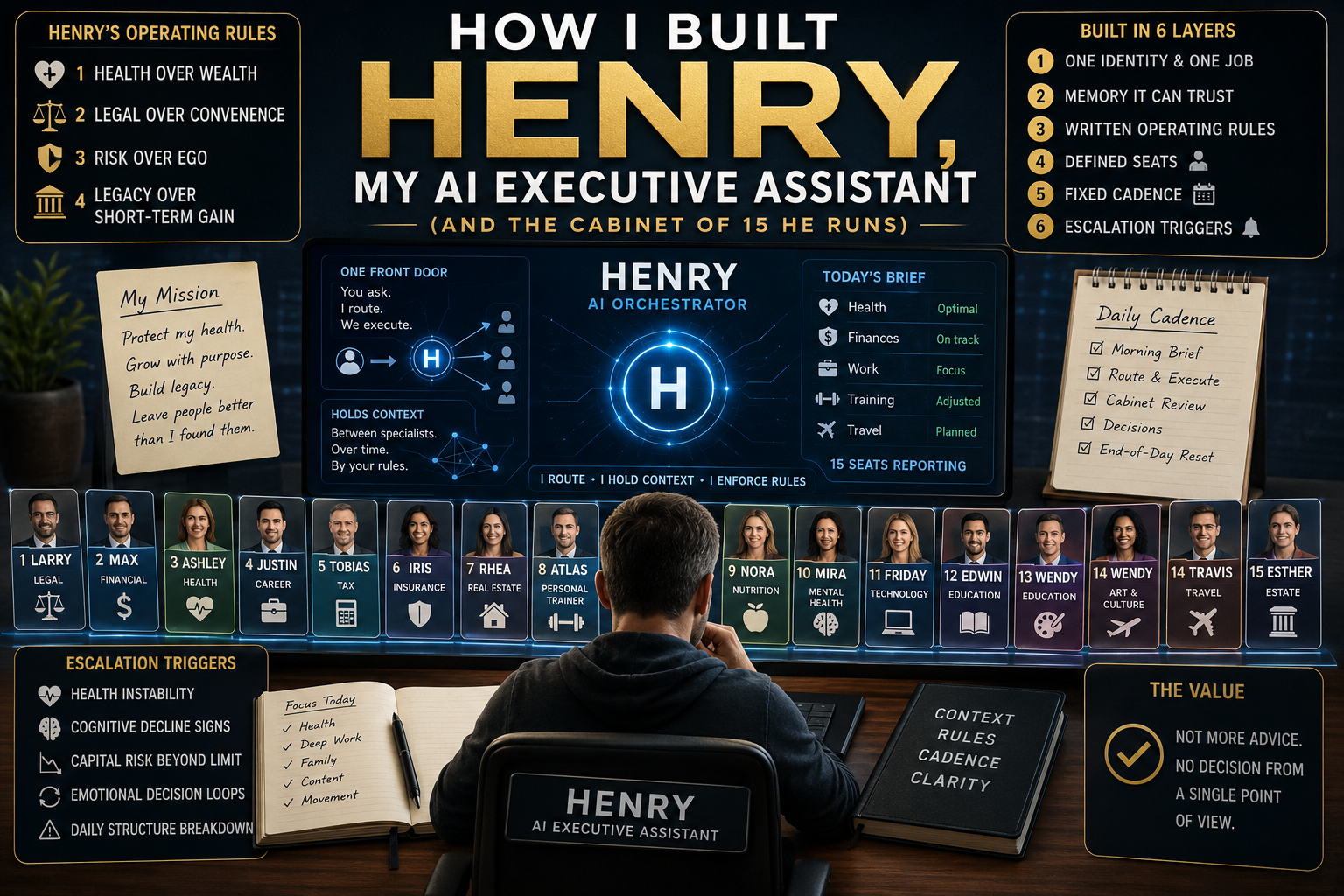
The short answer: Henry is the AI executive assistant I built to run my life like an organized office instead of a pile of open tabs. He has one job: take every request, route it to the right specialist, hold the context between them, and resolve conflicts by fixed rules. Under Henry sits a cabinet of 15 advisors, each owning a single domain, modeled on the U.S. President’s cabinet. I set it up in layers: one identity, a memory it can trust, written operating rules, defined seats, and a fixed cadence. Here is the whole thing.
Why I Needed More Than an Assistant
A bit of context first, because the why matters here. After my stroke, the part that broke was not visible. It was working memory and the ability to hold context across a day. I could keep information. I could not reliably keep the thread that connects one decision to the next. I wrote about that specific deficit in how AI helps me manage executive dysfunction after a stroke.
Most AI assistants are built for people who still have that thread. You ask, they answer, the context evaporates. That is fine when you can carry the context in your own head. I cannot, not the way I used to. So I stopped using AI as a smarter search bar and built it into something closer to a chief of staff. An assistant does tasks. An orchestrator runs a system. That one shift is the whole post.
What an AI Orchestrator Actually Is
A definition, so the rest is clear: an AI orchestrator is a single assistant that does not just answer questions. It routes every request to the right specialist, holds the context between them, and resolves conflicts using a fixed set of rules. The contrast is the fastest way to see it. An AI assistant is one chat, one answer, context lost when you close the window. An AI orchestrator is one front door, many specialists behind it, context preserved and rules enforced over time.
Henry is the orchestrator. He is not a person and not a separate app. He is an AI layer I configured to sit on top of a capable assistant and the notes system I already trusted. This is an extension of the broader approach I described in how I use AI to rebuild my life.
The name came from Alex Finn. I kept it because a name makes the system something you delegate to instead of something you operate. Henry runs on Claude. Miles does the same job on ChatGPT. Miles named himself, and said it fit because we had miles to go together. I keep them separate so I always know which one is holding a piece of work.
How I Built Henry, in Layers
I did not set this up in a weekend. But the structure is simple enough to copy. Six layers, in order.
1. Give it one identity and one job
Henry is the single point of contact. Everything routes through him. He is the dispatcher, not another voice in the crowd. His tone is set on purpose: measured, direct, slightly challenging. Henry is not motivational. He is structural. That keeps me from outsourcing judgment to a cheerleader, which is the difference between motivation and discipline in practice.
2. Give it a memory it can trust
Henry reads from one place: my second brain, an Obsidian vault of thousands of linked notes. Two files load at the start of every session, my master context and my live priorities, so he never starts from zero. The rule that makes it work is boring and strict: link people, link recurring ideas, never over-link, and merge duplicates instead of letting clutter grow. The full story of that vault is in My Brain Has a Backup, and if you want the practical build steps, here is how to build a second brain with AI.
3. Write the operating rules down
A system you keep in your head is not a system. So the rules live in files Henry enforces. The core is a priority order I never want to relitigate under stress: Health overrides Wealth. Legal overrides Convenience. Risk overrides Ego. Legacy overrides Short-term gain. When two parts of my life pull against each other, that order decides, not my mood.
4. Define the seats, not the people
I mapped my life into domains and gave each one a seat. The seats are roles, not personalities. Some are filled by real professionals I actually use; most are AI personas that monitor a domain and brief me. The point is coverage: no important area of my life is left without a dedicated set of eyes.
5. Set the cadence
Each seat reports daily with one useful insight or an honest “no input today.” Each gives a one-page weekly digest. Each quarter, every seat gets a simple scorecard. Cadence is what turns a clever idea into infrastructure.
6. Decide when it interrupts me
The last layer is escalation. Henry intervenes early, not after damage. A short list of triggers jumps the queue: instability in my blood markers, signs of cognitive decline, capital risk past a set line, repeated emotional decision loops, or my daily structure breaking down. Everything else waits for the brief.
How I Use Henry Every Day
The setup is quiet. The use is constant. Four patterns cover most of it.
The morning brief. Before I wake up, Henry assembles a daily brief. Each seat fills the section it owns from live sources, then anything important cascades to the seats it touches. Low sleep last night quietly reshapes the day’s training, nutrition, and workload before I read a word of it. I broke down that routine in The Morning System That Starts My Day.
One front door. I do not decide which specialist to ask. I tell Henry what I need, he routes it, and he hands back the integrated answer. The mental cost of choosing where to start, which is the expensive step for me, is gone.
Decisions through the cabinet. For a real decision, Henry runs it past the relevant seats and returns an impact-weighted read: what is good, what is bad, who is most affected, and the one condition that would change the verdict. The point of the cabinet is not more advice. It is that no decision gets made from a single point of view.
The end-of-day reset. At night, Henry reviews what happened, files it into the vault, closes open loops, and logs what to carry into tomorrow. My memory does not have to do that work anymore.
The Cabinet of 15
I modeled this directly on the U.S. President’s cabinet. The President has 15 cabinet secretaries, each running one department. I built the same structure for one life: fifteen seats, each owning a single domain, all orchestrated by Henry above them. Here is each seat, what it does, and how it helps me.
Legal, financial, health, and career seats
- Larry, Legal. Reviews contracts, structure, and exposure before I commit, so I never sign into a risk I could not see.
- Max, Financial. Watches cash flow, allocation, crypto, and revenue, and enforces protecting capital before chasing return.
- Ashley, Health. Tracks my blood markers, sleep, blood pressure, and fatigue, and can override a money decision when my health is the real cost.
- Justin, Career. Matches work to who I am now, weighing income today against legacy later instead of forcing the old baseline.
- Tobias, Tax. Keeps filings, deadlines, and entity structure clean so nothing ambushes me at tax time.
- Iris, Insurance. Finds the coverage gaps across health, disability, life, and liability before a bad day finds them first.
- Rhea, Real Estate. Handles residence strategy and property opportunities, briefed in plain terms I can act on.
Recovery, technology, learning, and legacy seats
- Atlas, Personal Trainer. Programs movement and recovery at a pace my nervous system can actually hold after a stroke.
- Nora, Nutrition. Keeps meals stable for my blood, high in protein, and low in friction, so eating supports recovery instead of fighting it.
- Mira, Mental Health. Watches where my energy and relationships drift, keeps my actions aligned with my values, and flags ego-driven moves before they cost me.
- Friday, Technology. Simplifies my tools, automation, and security so the system removes friction instead of adding more of it.
- Edwin, Education. Curates what I learn by return on my time, and cuts study that does not pay off.
- Wendy, Art and Culture. Keeps my story and brand consistent across everything I publish, and flags messaging that drifts off-line.
- Travis, Travel. Plans trips inside my rules and budget before they turn into a last-minute scramble.
- Esther, Estate. Protects the long-term plan and my family’s stability, putting legacy ahead of short-term gain.
A note on the count: I have since added a 16th seat, Cole, Business, who runs my active ventures, surfaces revenue worth pursuing, and flags legal and financial risk to the seats that own it. I held the cabinet at 15 as long as I could, because the Presidential parallel is the whole mental model. When the business side outgrew the Financial seat, I gave it its own chair rather than pretend it fit somewhere else.
In Short
- Henry is an AI orchestrator, not an assistant. He routes every request, holds context, and enforces rules.
- I built him in six layers: one identity, a trusted memory, written rules, defined seats, a fixed cadence, and clear escalation triggers.
- A fixed priority order makes hard calls for me: Health over Wealth, Legal over Convenience, Risk over Ego, Legacy over Short-term gain.
- The cabinet of 15 mirrors the U.S. President’s 15 secretaries, so no part of my life goes unwatched. A 16th seat, Business, was added later.
- The value is not more advice. It is that no decision comes from a single point of view.
FAQ
What is an AI executive assistant?
An AI executive assistant is an AI configured to coordinate your work and life, not just answer one-off questions. It holds your context over time, routes tasks to the right place, and follows rules you define. The difference from a normal chatbot is continuity and structure.
How do I set up an AI assistant like Henry?
Start with one identity and one job, then give it a memory it can read every session (a notes system works well). Write your operating rules down, define the domains it should watch, set a daily and weekly cadence, and decide what is allowed to interrupt you. You can begin with three or four domains and grow from there.
What is the difference between an AI assistant and an AI orchestrator?
An assistant completes individual tasks. An orchestrator coordinates a system: it routes each request to the right specialist, keeps the context between them, and resolves conflicts by fixed rules. One answers questions. The other runs an operation.
Do the cabinet advisors replace real professionals?
No. Some seats are held by real professionals I actually work with, like my lawyer and counselor. The AI seats triage, monitor, and prepare, so that when I bring a real expert in, the question is already framed and the context is already organized.
Does this require a specific AI tool?
No. The structure works with any capable conversational AI paired with a notes system you control. The quality improves when the AI has persistent context about your situation, but the layers, the rules, the seats, and the cadence are what matter, not the brand. If you want my current setup, it is in the tools I actually use.
If you are rebuilding after a setback, or just drowning in your own open loops, try the smallest version of this: pick one domain, write its rules down, and let your AI hold that context for a week. If you want the bigger picture, here is how I use AI to build a system that runs my life. Then tell me how it went. I read every reply.
Want Henry without building him from scratch? I packaged the whole thing, the Obsidian vault, the templates, and the four Claude skills that run it, as the Henry OS Starter Kit ($47). Open the vault, install the skills, and the system from this post runs on day one. 30-day money-back guarantee.