
There is a famous exercise where you write down the worst thing that could happen, in detail, and then plan around it. Tim Ferriss calls it fear-setting and credits it with most of his good decisions. He borrowed the bones of it from the Stoics, who called it premeditatio malorum. The premeditation of evils.
It is a good exercise. I am not here to argue with it.
I am here to report from the other side of it. Fear-setting has a quiet assumption built in: the disaster is hypothetical. You imagine the wreck, feel the fear shrink under examination, then go back to your life, which is intact.
In 2023, at 35, I had a stroke. The thing the exercise asks you to imagine, the body failing, the work stopping, the identity coming apart, was no longer a writing prompt. It was my Tuesday.
So this is about what I learned when the worst case stopped being theoretical. And about the version of the exercise I do now, which runs in the opposite direction. I call it loss-setting.
Fear-Setting Assumes the Worst Case Is Hypothetical
The first thing the worst case teaches you is embarrassing to admit: I had spent years being afraid of the wrong things.
Before the stroke, my fears were ordinary: career, money, what people thought of me. Ordinary fears. The kind fear-setting is built to shrink.
The stroke did not appear anywhere on my list. And when it came, the things I had actually been afraid of revealed themselves as noise. The stroke handed me the thing I had feared most, the stares and the “is he broken?” looks, and then I found out that was all it was. People looking. And when you find out the worst case is just people looking, the fear doesn’t survive the meeting.
I do not say that to be dramatic. I say it because it changes the math of every fear that came after. Once the worst case has happened to you, your nervous system holds a piece of information most people never get: you have already watched yourself survive it. Not imagine surviving it. Watch it happen.
That information is expensive. I would not recommend acquiring it this way. But if you have it, and many of the people who read this site do, it is worth something, and most of us never cash it in.
The mental side of recovery is the part nobody warns you about, and I have written about it separately, because it deserves more than a paragraph.
What Is Loss-Setting?
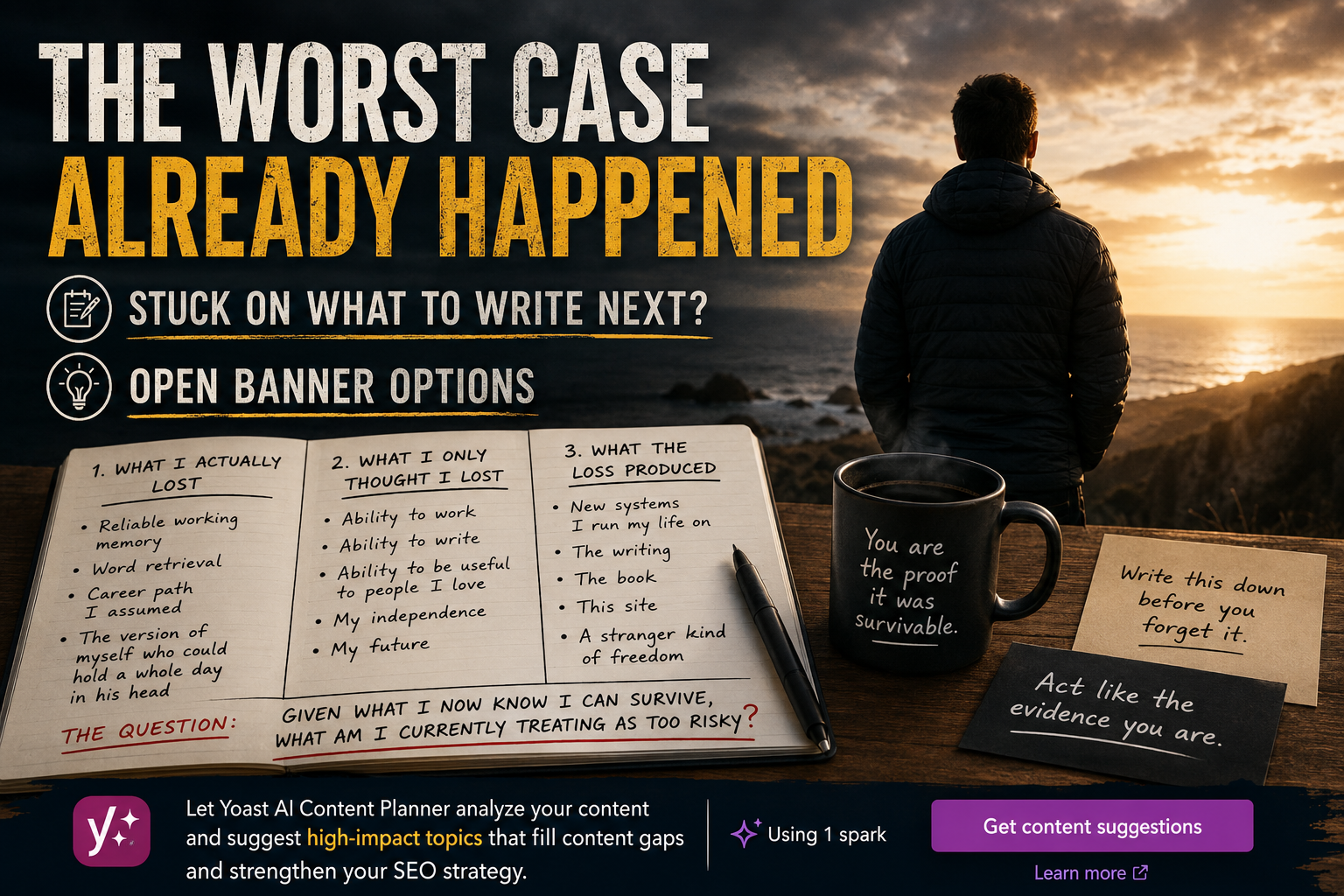
Loss-setting is a reflection exercise for people whose worst case has already happened. Where fear-setting asks you to imagine disaster and plan around it, loss-setting asks you to look backward and itemize what a real loss actually cost you. Three columns, one question at the bottom. It turns survival into usable evidence.
I sit down with three columns, same as Tim’s version, pointed backward.
Column One: What You Actually Lost
In the first column I write what I actually lost. Specifically. Not “everything changed.” Specifics. The working memory. I used to carry everything in my head and it just stayed there; now I write everything down because if I do not, it is gone. That is a discipline I did not choose. The ability to type like a regular person. My left side does not do what I ask, and typing used to be both hands. The career path that would have been obvious if the stroke had not happened. That path is closed. I do not know its name anymore, only that it is not available.
The discipline is the same as fear-setting: vague dread shrinks when you make it itemize itself. So does vague grief.
Column Two: What You Only Thought You Lost
In the second column I write what I was sure I had lost at the time, but had not. This column is always longer than I expect.
I was sure I had lost the ability to use a computer as someone normally would. I had not. I found Wispr Flow, which lets me type with my voice instead of my hands, and it turned out there was a version of the thing that still worked. It is slower in one way and faster in another, and it works. I was sure I had lost writing. I had not. It took time and reps and help, but the loss I grieved in the hospital was bigger than the loss that proved real.
Some of the heaviest losses after a stroke are the ones nobody can see. I wrote about the invisible losses after stroke before, because most of what you grieve is what no one else can see.
Column Three: What the Loss Produced
In the third column I write what the loss produced. Not silver linings. I have no patience for the idea that a stroke is secretly a gift. The stroke was a stroke.
But it is also a fact that the systems I now run my life on, the writing, the book, this site, all of it came after, and most of it came because. The third column does not make the loss good. It makes the loss not be the end of the accounting.
The Question at the Bottom
Then one last line at the bottom, the question the whole exercise exists for: given what I now know I can survive, what am I currently treating as too risky?
That line is where the exercise stops being therapy and starts being strategy. Publishing the book came out of staring at that line until the excuse died. I was afraid of what people would think of it, and what they would think of me for writing it, and the line asked a question I already had the answer to: had I survived worse? Yes. Had the thing I feared most already happened and turned out to be survivable? Yes. The fear had nothing left to stand on.
That was discipline, not motivation, and I have written about motivation vs. discipline before, so I will not redo it here. The line worked because I kept coming back to it.
FAQ: Loss-Setting vs. Fear-Setting After the Worst Case
If your worst case has not happened, I am glad. Do Tim’s version. It works, and you will be better prepared than the people who skip it. Loss-setting is not a replacement for fear-setting. It is what you do with the evidence afterward.
But if your worst case already came, the diagnosis, the divorce, the loss you do not say casually at parties, then fear-setting is the wrong tool. You do not need to imagine surviving. You need to count what survived with you.
What is loss-setting?
Loss-setting is a backward-looking exercise I built after my stroke in 2023. You write three columns: what you actually lost, what you only thought you lost, and what the loss produced. Then you ask what you are still treating as too risky. It is fear-setting’s opposite: you plan from what already happened, not from what might.
How is loss-setting different from fear-setting?
Fear-setting asks what is the worst that could happen, then plans around that imaginary disaster. Loss-setting asks what is the worst that did happen, and what it actually cost. Fear-setting prepares you for a hypothetical future. Loss-setting accounts for a real past, then asks what you are still flinching from out of habit.
What are the three columns in loss-setting?
Column one is what you actually lost, written in specifics. Column two is what you were sure you lost but had not, which is usually longer than you expect. Column three is what the loss produced, not silver linings, just what came after. Then one question at the bottom: what am I still treating as too risky?
Does loss-setting work if my worst case hasn’t happened?
It is aimed at people who already survived something, but the shape works for anyone. If your worst case has not happened, fear-setting is the better tool: it is cheaper, and it prepares you well. Loss-setting is for when the fear is no longer hypothetical, when you need to count what survived instead of imagining what might.
Write This Down
I wrote once about how the stroke crushed my ego, and how losing the ability to hide turned out to be a strange kind of freedom. Loss-setting is the same mechanism on paper. You cannot be held hostage by a fear whose ransom you have already paid.
Three columns. What you lost. What you only thought you lost. What the loss produced. Then the question at the bottom.
Write this down before you forget it. I keep mine in a bullet journal, because the columns need a grid and a place you will come back to, but a blank notebook works just as well.
The worst case already happened. You are the proof it was survivable. Act like the evidence you are.