
The short answer: AI works for brain fog when you stop treating it like a search engine and start treating it like a cognitive prosthetic: a tool that stands in for the specific function that’s struggling. The word that won’t come. The task you can’t start. The email you can’t parse. I collected the 44 prompts I actually reach for into the AI Cognitive-Prosthetic Prompt Pack.
I’m Blake. I had a stroke at 35. AI didn’t make me more productive afterward. It made me feel like myself again. Different thing entirely.

What Is a Cognitive Prosthetic?
A cognitive prosthetic is any tool that compensates for a gap in thinking, memory, or processing.
A sticky note is one. So is a calendar reminder. Humans have always built external supports for memory and attention.
AI is different in one way that matters: it can meet you mid-struggle. A sticky note can’t help you find a word. AI can.
Why Generic AI Advice Fails People With Brain Fog
Most AI advice assumes you can write a good prompt on demand. But writing a good prompt is itself a cognitive task, and on a foggy day, that’s exactly what you can’t do.
It’s a loop: you need help because your brain is struggling, but getting help requires the thing your brain can’t do.
The fix is to write the prompts once, on a good day, and reuse them forever. Copy, paste, fill in one blank. No composing required.
The 8 Moments Where AI Actually Helps
After a few years of daily use, my prompts sort into eight situations:
- Finding the word that won’t come. Describe the shape of it, AI offers candidates.
- Planning and doing things in order. Turn a vague task into numbered steps.
- Understanding and summarizing. Shrink the email or document you can’t read today.
- Decision fatigue. Hand AI the options and let it structure the choice.
- Steadying emotion and overwhelm. Get the noise out of your head and sorted.
- Memory and keeping track. Externalize what you’d otherwise lose.
- Communicating with people. Say the hard thing clearly without spending all day on it.
- Identity and rebuilding. The deeper work of figuring out who you are now.
The prompt pack has 44 prompts across these eight areas. Each one includes a short note on when it helps, and they work with any assistant: ChatGPT, Claude, Gemini, or the one on your phone.
How to Start (3 Steps)
Pick your worst moment. Word-finding, task paralysis, unreadable emails. Choose one.
Save one prompt for it. Write it once or use a pre-written one. Keep it where you can copy it in five seconds.
Use it without judgment. Using a ramp isn’t cheating for a wheelchair user. Using AI isn’t cheating for a healing brain.
Needing support is not the same as being less capable. It’s how capability gets rebuilt.
Where to Keep Your Prompts
A prompt you can’t find is a prompt you don’t have. Keep them one tap away:
- On your phone’s notes app, pinned.
- Printed, if paper is your thing. The pack is a large-type PDF for exactly this reason.
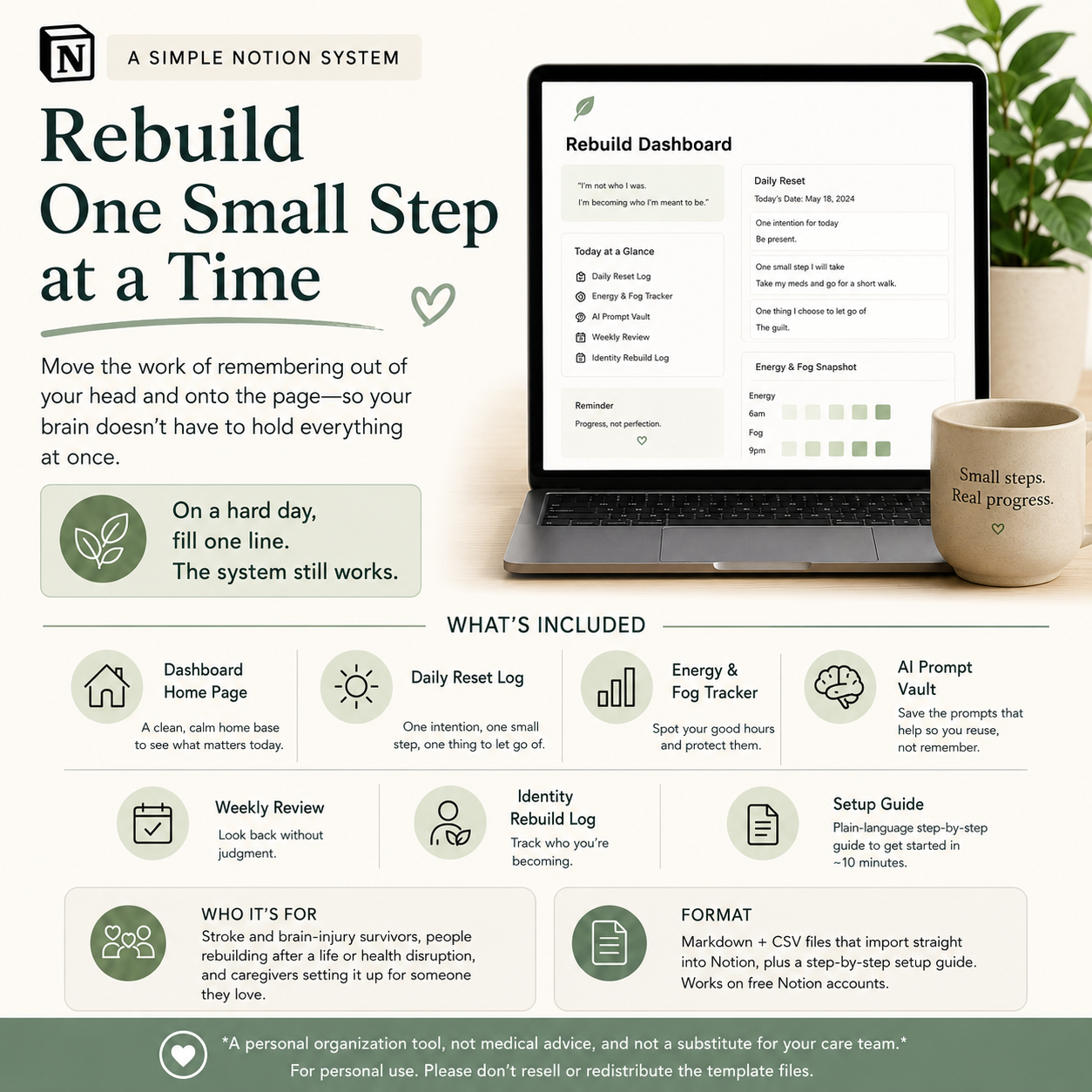
- In an AI Prompt Vault inside a recovery system. The Brain Recovery Dashboard for Notion has one built in.
And for the reflection side of recovery, the part AI can’t do for you, I use the One Day Forward journal alongside these prompts.
In Short
- AI helps brain fog when used as a cognitive prosthetic, not a search engine.
- Writing prompts is itself a cognitive task. Write them once, reuse forever.
- Eight moments matter: words, planning, understanding, decisions, emotion, memory, communication, identity.
- Keep prompts one tap away or they don’t exist.
Get it here: AI Cognitive-Prosthetic Prompt Pack ($9.99). 44 plain-language prompts. Instant download, large readable type.
FAQ
What is a cognitive prosthetic?
Any tool that compensates for a gap in thinking, memory, or processing. A sticky note qualifies. AI is the first one that can respond to you mid-struggle.
Do I need a paid AI subscription?
No. The prompts work with free versions of ChatGPT, Claude, Gemini, or the assistant on your phone.
Is this only for stroke survivors?
No. It’s written for stroke and brain injury survivors, but it fits anyone with brain fog, plus the caregivers and therapists who support them.
Is this medical advice?
No. It’s a self-help tool, not medical or therapeutic advice, and not a substitute for your care team.
How is this different from free prompt lists?
Each prompt is built for a specific struggling moment, includes when to use it, and skips jargon. It’s the set I actually use, not a content farm list.
This post describes a self-help tool. It is not medical or therapeutic advice.
These prompts work best inside a system that remembers for you. That system is explained in My Brain Has a Backup.