
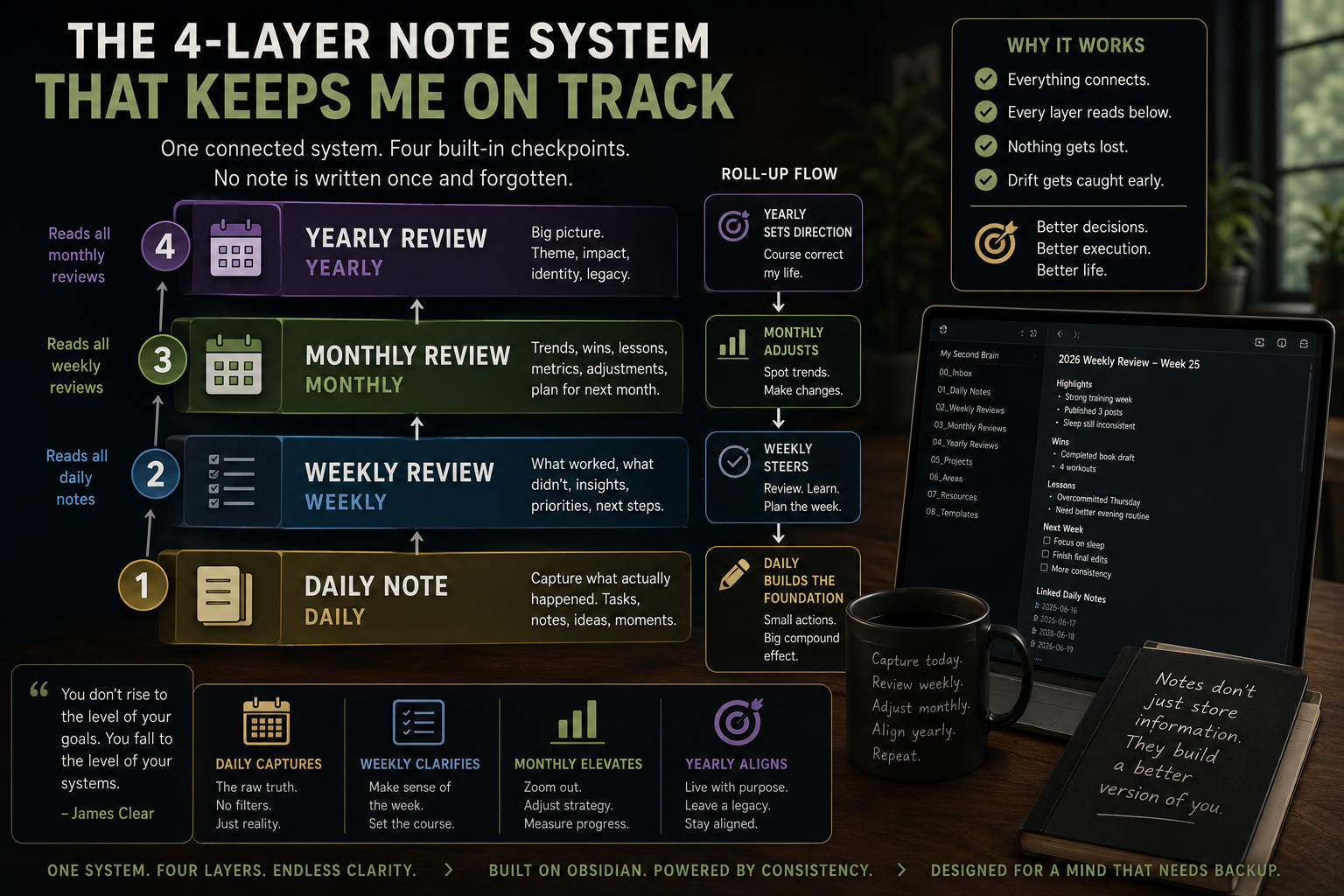
The short answer: I run one connected, compounding note system with four layers. A daily note captures what actually happened. Every week, the daily notes roll up into a weekly review. At the end of each month, those weekly reviews roll up into a monthly review. Once a year, the monthly reviews roll up into a yearly review. Every layer reads the layer beneath it. So no note is written once and forgotten, and I get four built-in checkpoints to catch drift and change course before a bad week becomes a lost quarter.
Most note systems fail for one reason: people capture, but they never review. The notes pile up, the system gets heavy, and none of it ever comes back to change a decision. This compounding note system is the version that fixed that for me. Here is the whole thing from the inside.
What is a compounding note system?
A compounding note system is one where small daily entries get reviewed and rolled upward, so today’s note still affects a decision a year from now.

That is the only idea that matters here. Capture is the easy part. The system is in the review. The value lives in the roll-up: the moment a week of scattered notes becomes one clear paragraph, and that paragraph becomes part of a month, and the month becomes part of a year.
I started building this seriously after a stroke, when I stopped trusting my memory to hold the threads between one day and the next. I needed an external memory system that remembered for me and, more important, one that told me when I was repeating a mistake. That second part is what most people miss.
Here is how the four layers fit together.
Daily Note + 3 briefs (morning, midday, end-of-day) → Weekly Review (GAP + WARP) → Monthly Review (GAP + WARP) → Yearly Review (themes, lessons, pivots). The arrows go up; the yearly review sets the direction every daily note is supposed to serve, so the system is a loop, not a stack.
Layer 1: How I use the daily note
The daily note is the raw material. Everything above it is made from it. I do not write one long entry. I run three light touchpoints across the day:
Morning brief. Before the day starts, a brief that starts my day already knows my priorities, my health constraints, my active projects, and what I said I wanted to focus on this year. I start from a clear position instead of from zero.
Midday recalibration. A short check halfway through. Am I still on the one thing that matters, or did the day quietly pull me sideways? This is the first and smallest place I pivot.
End-of-day reset. I close the day by naming what got done, what slipped, and the one open loop that carries to tomorrow. It also logs a single lesson.
The daily note is not a journal of feelings. It is a record of behavior: what I actually did, not what I intended to do. That distinction is what makes the weekly review honest later.
The rule at this layer: keep it cheap. A daily note you dread is a daily note you abandon. Low friction in, signal out.
Layer 2: The weekly review (GAP + WARP)
This is where the notes stop being a log and start being a system. Once a week I read the past seven days of daily notes and write one structured review. I stack two small frameworks.
GAP stands for Goal, Action, Plan. WARP stands for Wins, Aspirations, Results, Pivots.
GAP is the accountability half:
- Goal: what I was actually pursuing this week.
- Action: the behaviors that happened, stated plainly.
- Plan: and this is the key line, did I follow last week’s plan? If the same task slips three weeks running, it is not a task. It is a decision you keep avoiding. Naming it that way changes what I do about it.
WARP is the reflection half. Wins worth keeping. Aspirations, the identity I am moving toward. Results, an honest read of whether my behavior matched that aspiration. And Pivots, the specific adjustments I am making next week because of what this week showed. (This is also how I find what’s quietly stuck.)
I close every weekly review with three to five needle-movers for the coming week. Not a wish list. Things that actually move something.
The weekly review is where most recalibration happens. A single day is too short to see a pattern. Stretch it to a month and you have already waited too long. The week is the right resolution to catch drift while it is still cheap to fix.
Layer 3: The monthly review, written twice
The monthly review is built from the four or five weekly reviews underneath it. Same GAP and WARP structure, wider lens. I write it in two passes, and this is the part I think is underrated:
- At the start of the month, I write the intentions: the goal, the planned actions, and the specific outcomes I am committing to.
- At the end of the month, I come back and complete it: wins, results, what I learned, and the pivots for next month.
Writing the same document forward and then backward turns the month into a closed loop. The version I hoped for and the version that happened sit on the same page. The gap between them is the most useful thing I read all month.
The questions here are deliberately uncomfortable. What did I learn about myself this month? Where am I going wrong in a way that needs to be fixed? And what weight am I carrying that I do not need to carry? A week is for tactics. A month is for patterns.
Layer 4: The yearly review and next year’s intentions
The yearly review rolls the months up into themes. By the time I write it, I am not reconstructing the year from memory. I am summarizing twelve monthly reviews that already summarized the weeks that summarized the days. The work is mostly done. I am reading my own evidence.
At this layer I look for three things: the patterns that repeated all year, the lessons that cost me the most, and the pivots that worked. Then I write next year’s intentions in operational terms, not as resolutions. Not “be healthier,” but the actual daily structure and the standard that decides what stays. A line I keep at the top: if it does not compound, it does not stay.
Those intentions flow back down into every morning brief. The loop closes. That is the dotted arrow in the diagram.
Capture vs. review, and goals vs. systems
Two contrasts hold the whole thing together.
Capture vs. review. Capture is writing things down. Review is making them matter. A system that only captures becomes a graveyard. A system that reviews becomes a compass.
Goals vs. systems. A goal is a destination. A system is the loop that checks whether you are still walking toward it. Goals tell you where you want to be. Reviews tell you where you actually are. You need both, but only one of them tells you the truth.
The compounding note system in short
- One note system, four layers: daily, weekly, monthly, yearly.
- Each layer is built from the layer beneath it, so notes compound instead of piling up.
- The daily note records behavior, not intentions, across a morning brief, a midday recalibration, and an end-of-day reset.
- The weekly review uses GAP (Goal, Action, Plan) and WARP (Wins, Aspirations, Results, Pivots) and is where most course-correction happens.
- The monthly review is written twice: forward as intentions, backward as results.
- The yearly review rolls months into themes and sets next year’s direction, which flows back into the daily note.
- The point is not capture. The point is recalibration: catching drift while it is still small.
FAQ
What is a compounding note system?
A note system where small daily entries are reviewed and rolled up into larger reviews, so each note keeps affecting decisions long after you write it. The value comes from the review, not the capture.
What is the difference between GAP and WARP?
GAP (Goal, Action, Plan) is the accountability layer: what you aimed for, what you did, and whether you followed last week’s plan. WARP (Wins, Aspirations, Results, Pivots) is the reflection layer: what worked, who you are becoming, whether your behavior matched that, and what you will change.
How do you turn daily notes into a weekly review?
Once a week, read the past seven daily notes and write one structured review using GAP and WARP. You are synthesizing what already exists, not remembering from scratch, which is why it stays fast.
How long does the weekly review take?
Usually 30 to 45 minutes, because the daily notes already did the capturing.
Do I need special software for the compounding note system?
No. I use Obsidian, a folder of linked markdown files, but the structure works in any notes app. The four layers and the roll-up are the system. The tool is just where it lives.
Where does recalibration happen in the compounding note system?
At every layer, but mostly weekly. The midday check catches drift inside a day, the weekly review catches it inside a week, and the monthly and yearly reviews catch the slow patterns a week is too short to see.
If you have ever built a beautiful notes setup and then watched it turn into a pile you never reopen, the missing piece was probably review, not capture. Start with the smallest version: write a plain daily note for one week, then spend 30 minutes reading the week back and asking what you would change. That single habit is the seed of the whole system.
Want the exact weekly and monthly review templates I use?
I packaged this exact system into a downloadable pack called Anchor: the
daily, weekly, monthly, and yearly note templates from this post, built for
Obsidian and any Markdown editor. Same four layers, same roll-up, ready to
drop into your vault. No plugins required, and the files are yours to keep.
Get the Anchor template pack → anchor note system
This post is part of the system I describe in My Brain Has a Backup, the AI second brain that runs my day.